Why Western Builders Are Shifting to Aluminum Entry Doors: A Market Outlook for 2027
Ask a builder in Texas, Ontario or Queensland what they specified for a front door ten years ago and the answer is usually steel, timber or fiberglass. Ask the same question against a 2027 tender and aluminum keeps appearing on the schedule — not as a commercial material borrowed for residential work, but as the default answer for large, glazed, low-upkeep entrances.
Quick answer: aluminum is taking share in Western entry door specifications because four things changed at once — openings got larger, energy codes moved from glass-only to assembly-level performance, coastal and freeze-thaw exposure became a bigger slice of new housing, and owners began pricing maintenance over twenty years instead of at handover. It is not the cheapest option per leaf. It wins where size, exposure and life-cycle cost matter more than first cost.
The Material Mix Is Moving, Not Flipping
Steel and fiberglass still hold most of the North American residential entry market, and timber remains the reference in parts of northern Europe. What is changing is the direction of travel in the most visible segments: custom single-family, high-end renovation, and mid-rise residential with a glazed, oversized entrance. There aluminum has moved from occasional upgrade to a line item architects write themselves.
Reported material shares vary by source and region, so any single percentage deserves suspicion. The useful signal sits in the specification: when a project needs a leaf taller than about 2.4 metres, or glass over half the door face, the shortlist narrows quickly to aluminum.
Five Forces Driving the Change
1. Weather exposure became a design input
Steel depends on a coating that survives every scratch; timber depends on a refinishing cycle. Aluminum forms its own oxide layer, and a factory-applied powder coat tested to AAMA 2605 or an anodized finish to AAMA 611 holds colour and gloss through decades of salt spray and ultraviolet. On a coastal build that decides whether the door is still sealing at year fifteen.
2. Energy codes reached the whole assembly
The IECC, the NFRC labelling programme, ENERGY STAR door criteria and Passive House targets now cap the U-factor and air leakage of the complete assembly, not just the glazing. A thermally broken aluminum frame with a polyamide isolator, warm-edge spacer and low-E insulating glass meets those figures in a profile that stays visibly slim.
3. Openings keep getting wider
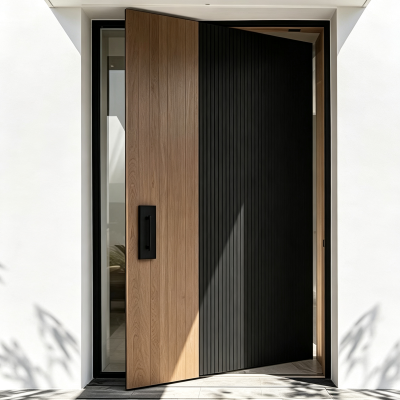
A 2.4 by 1.2 metre leaf is routine in aluminum, an engineering exercise in steel, and a movement problem in timber. The stiffness-to-weight ratio allows taller leaves, narrower stiles and larger glass — exactly what flush faces, minimal frames and pivot operation demand.
4. Life-cycle cost beat first cost
Painted steel in a humid climate typically needs repainting inside a decade; timber needs refinishing every few years; aluminum needs washing. Where the owner carries maintenance, that lands in the operating budget long before the warranty expires.
5. Procurement diversified
Long domestic lead times pushed buyers to qualify overseas fabricators, bringing custom sizes, RAL finishes and dual-colour leaves to volumes once reserved for commercial orders.
How the Specification Changes on Site
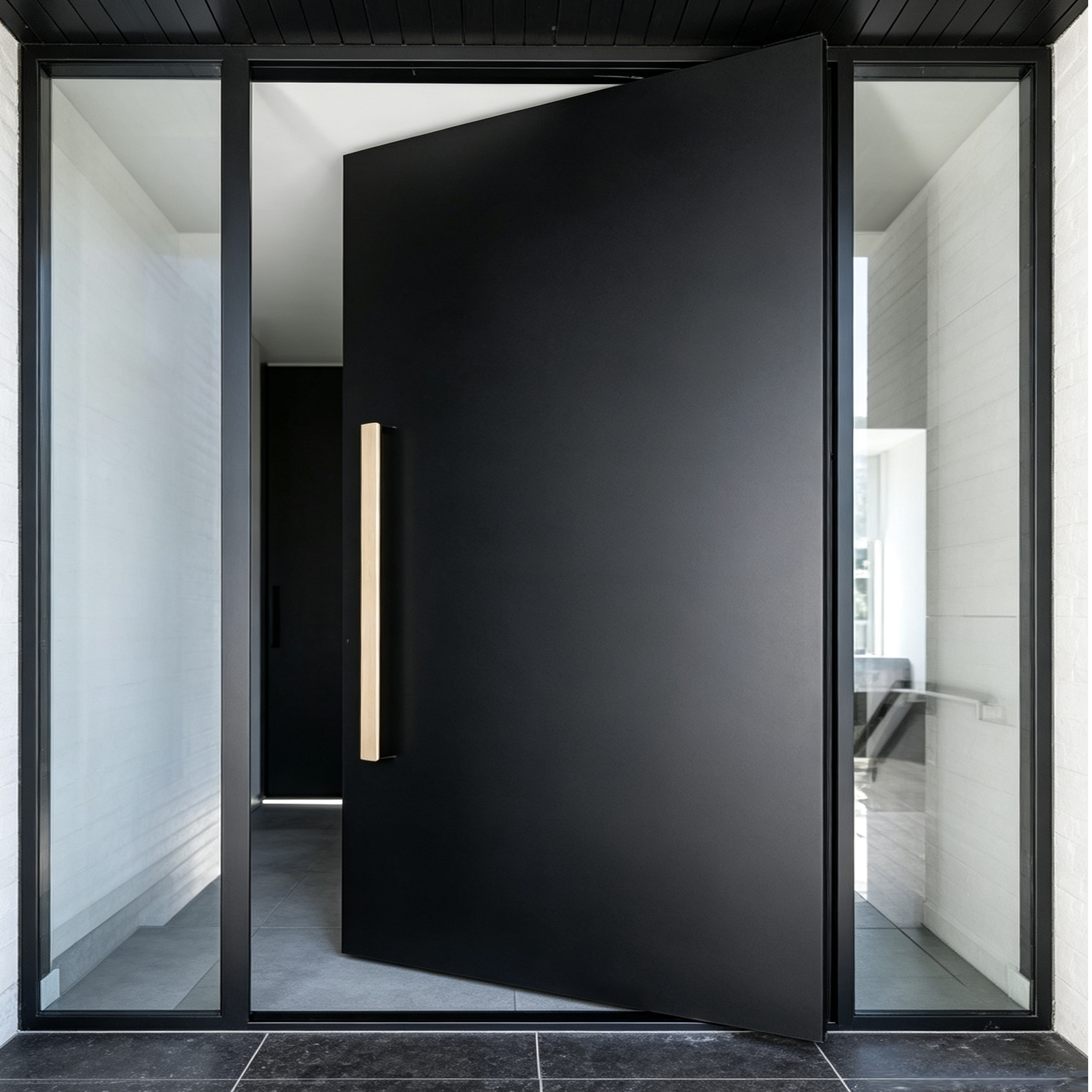
- Structure, not just finish. Lighter leaves simplify blocking and anchors, but the frame still has to be shimmed for wind load — especially pivot doors, where the load lands on a floor-mounted pivot set.
- Thermal breaks must be continuous. A break that stops at the corners is a cold bridge, and a cold bridge is condensation in the first cold snap. Ask for a section drawing, not a photo of a corner.
- Hardware is mortise-first. Most aluminum entry doors are built around a DIN-style mortise case, which is what lets multi-point and electronic locks fit without surface-mounted retrofits later.
- Tolerances are tighter. Aluminum does not absorb site error; rough openings must be square and plumb within a few millimetres.
Entry Door Materials Compared
| Material | Corrosion and weather | Practical leaf size | Maintenance cycle |
|---|---|---|---|
| Thermally broken aluminum | Excellent; oxide layer plus AAMA-rated finish | Very large, including 2.4 m+ leaves | Wash and lubricate annually |
| Steel | Good while coating is intact; edges corrode first | Moderate; large leaves need reinforcement | Repaint every 8 to 12 years |
| Timber | Finish-dependent; moves with moisture | Moderate; tall leaves need engineered cores | Refinish every 2 to 5 years |
| Fiberglass | Very good and dimensionally stable | Limited by mould tooling | Occasional cleaning |
Where Aluminum Still Loses
- First cost. A thermally broken aluminum entrance with insulating glass usually costs more per leaf than a stock steel or fiberglass door of the same nominal size.
- Denting. Aluminum skins are softer than steel, and a thin skin shows impact marks sooner on a family entrance with bicycles and parcel deliveries.
- Acoustics are assembly-dependent. A heavy leaf alone does not stop traffic noise; gasket compression and laminated glass do most of the work.
What Buyers Should Ask Before the 2027 Season
- Which standard is the finish tested to, and what is warranted in writing? Ask for AAMA 2605 or AAMA 611 by name.
- What is the maximum leaf size at the specified wind load, and does the hardware schedule support it?
- How is the assembly packed for sea freight, and what handling instruction arrives with it on site?
- Can a corner sample and colour chip be approved before production? Colour is the most common dispute on delivered orders.
The practical conclusion for importers is to buy the assembly rather than the leaf. Frame, threshold, gasket stack, hardware preparation and packing decide whether the door performs on site; the profile is only the start. Landran Door supplies aluminum entry, pivot and double doors from Foshan as complete assemblies.
Four Signals to Watch Through 2027
- Assembly-level code reporting. More jurisdictions will ask for whole-assembly U-factor and air-leakage data, not glazing-only figures.
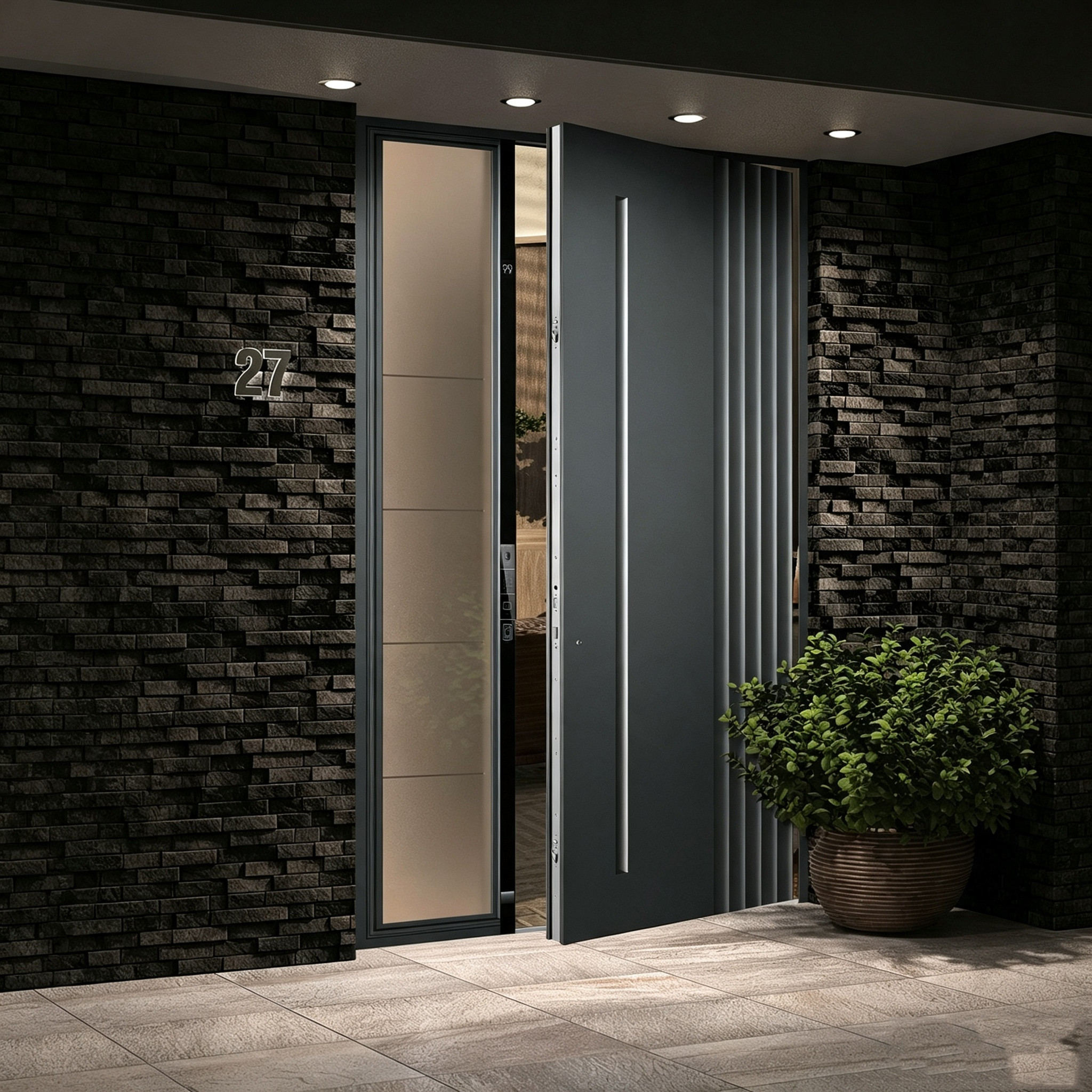
- Flush faces and concealed hinges. The panelled entrance is losing ground in high-end work, favouring a material that holds a flat face over a tall leaf.
- Dual colour as a catalogue option. Dark exterior with a pale interior is drifting from custom ask to standard configuration.
- Electronics designed in. Wiring routes, mortise cavities and backup power for smart locks are prepared at the factory rather than cut on site.
The Bottom Line
Aluminum is not replacing steel and timber across the whole market, and it does not need to. It is winning the part that is growing: large, glazed, exposed entrances where the owner intends to still be in the building in twenty years. For builders the shift is mostly a specification question — get the thermal break, hardware preparation and packing right, and the material argument has been settled by the physics.