Single Door vs Double Door vs Pivot Door: Which Configuration Fits Your Home?
Three entrance configurations cover almost every residential opening: a single leaf, a pair of leaves, or one large pivot leaf. They differ far more in swing geometry, structural load, hardware and cost than in appearance, which is why the configuration should be settled before the finish.
What Single, Double and Pivot Actually Describe
All three are aluminum entrance doors; the difference is how the leaf moves and what carries it. A single door hangs one leaf on a hinge jamb. A double door splits the opening between an active leaf and a secondary leaf. A pivot door hangs one large leaf on a vertical axis set into the head and sill rather than a jamb. That difference cascades into clearance, hardware, sealing and how the entrance reads.
Quick answer: start with two numbers, not a photograph. The clear opening width and the interior swing clearance you can spare will usually eliminate one or two options before style is discussed.
Single Leaf: The Default for Most Openings
A single leaf is the most common configuration because it is the simplest to hang, seal and service: one perimeter gasket line, one lock set, and a load path that travels into a conventional hinge jamb.
Where a single leaf stops working
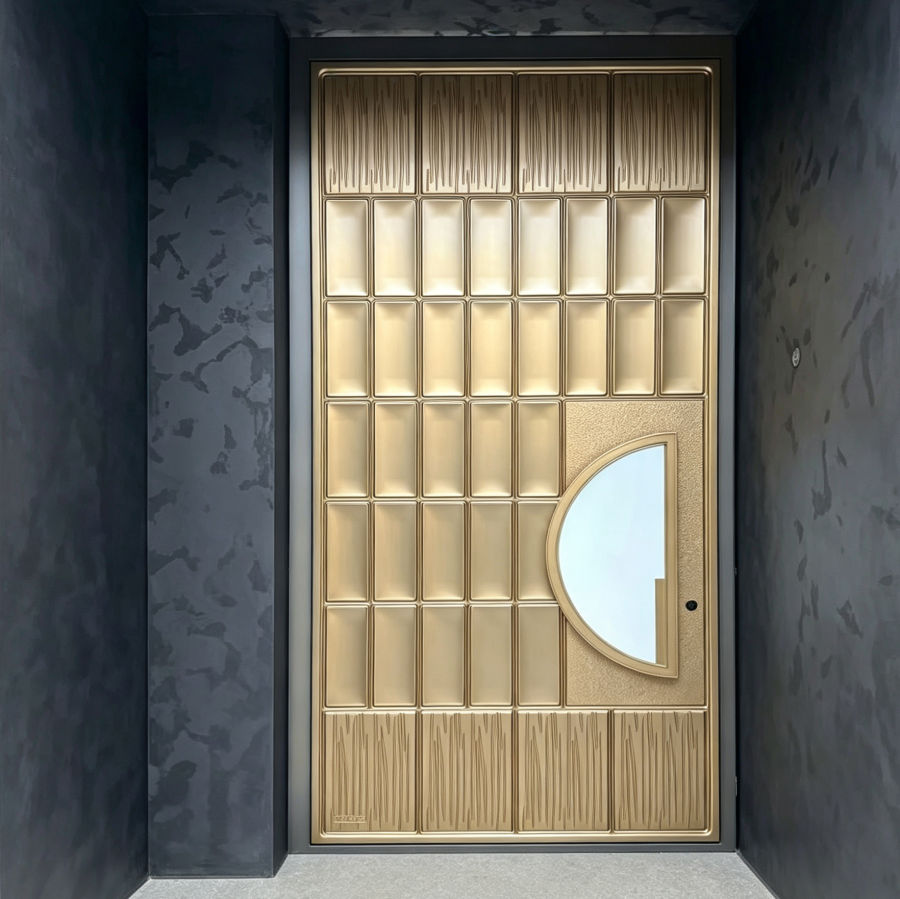
A hinged leaf sweeps an arc roughly as deep as it is wide, so a 1,000 mm leaf claims a metre of floor. Past roughly 1,100 mm of leaf width the leaf becomes heavy, hinge-side load rises, and a pivot starts to make more sense.
Double Leaf: Two Leaves, One Opening
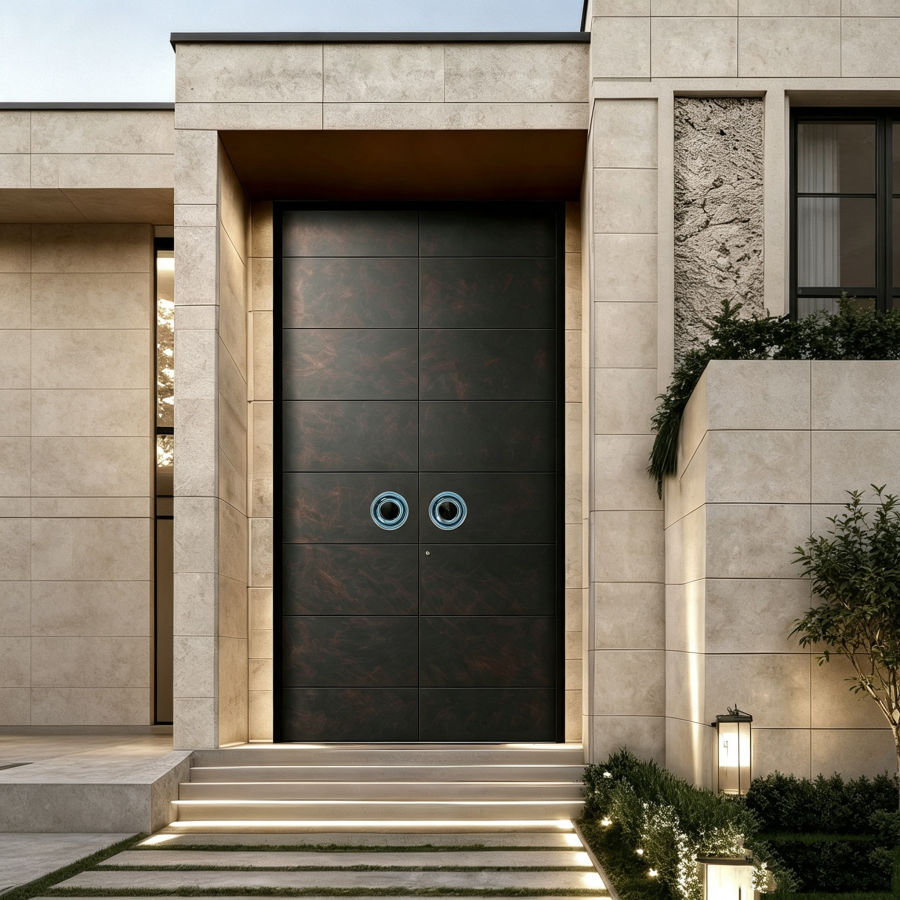
A double door splits the opening into two leaves on facing jambs: an active leaf carries the lock while a secondary leaf is held by flush bolts. An opening unmanageable as one leaf becomes two lighter leaves, each within what a hinge set and a person can move.
The trade-off is the meeting stile
Where two leaves meet, there is a joint to seal and keep square — the hardest part of any double entrance. An unequal double door, such as Z-025, pairs a wide everyday leaf with a narrower secondary leaf to keep daily use light.
Pivot: One Large Leaf on a Vertical Axis
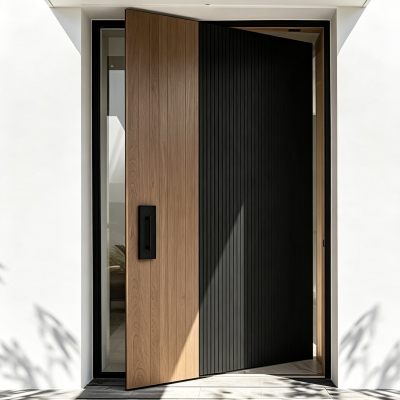
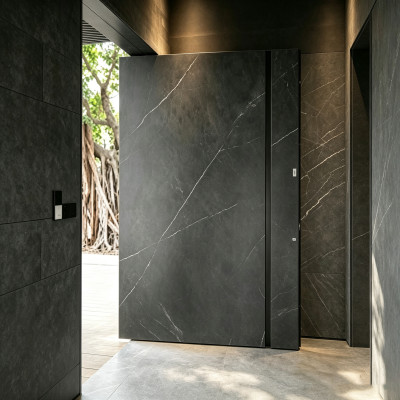
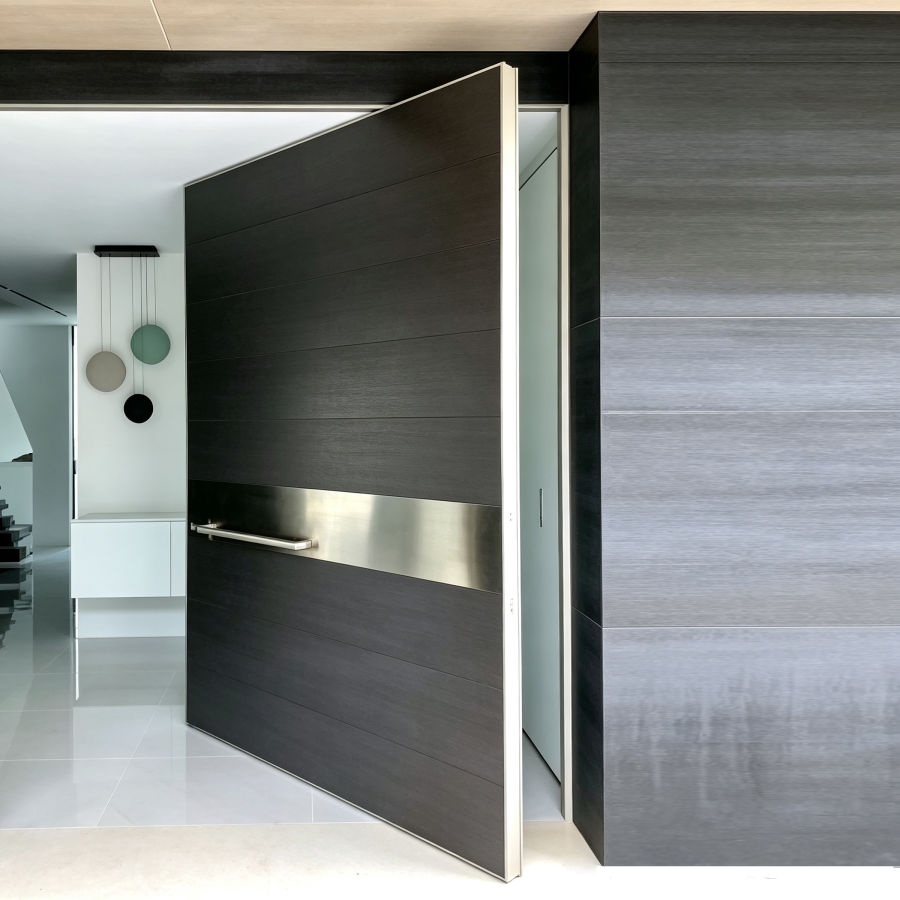
A pivot door carries a single leaf on a bearing set into the frame head and sill, inboard of the leaf edge. Nothing is visible on the face and the swing arc can be tuned by moving the axis. The load travels into the floor and head rather than a jamb, so finished leaf weight must be known before the carrier is chosen.
Clearance behaves differently
Because the axis sits inboard, part of the leaf swings outward while part swings inward, so a pivot needs less interior arc than a hinged leaf of the same width. That is its main advantage in tight entrances and its main complication when sealing the pivot aperture.
The Three Configurations Side by Side
| Aspect | Single leaf | Double leaf | Pivot |
|---|---|---|---|
| Carrier | Hinge jamb | Hinges on two jambs | Head and sill bearing |
| Load path | Into the jamb | Into both jambs | Into floor and head |
| Interior arc | Full leaf width | Two overlapping arcs | Reduced, splits in and out |
| Sealing lines | Perimeter only | Perimeter plus meeting stile | Perimeter plus pivot aperture |
| Alignment risk | Low | Meeting stile | Bearing and sill |
Hardware and Wind Load Do Not Transfer
Hinge sets, pivot carriers, flush bolts, multipoint locks and concealed closers are specific to a configuration. A pivot carrier such as the H-001 hinge for aluminum pivot doors is rated for a leaf mass and dimension, while a handle sized for a light single leaf may be wrong for a heavy pair. Fixing the configuration before the hardware is the normal order.
Wind load acts on area, so a large pivot leaf presents more area than a single leaf serving the same opening. On an exposed site, leaf size, gasket lines and frame rebate depth matter more than the finish, so state the exposure in the enquiry.
Which Configuration Fits the Elevation
A single leaf reads as a door, a double leaf reads as a gateway whose symmetry suits formal elevations, and a pivot leaf reads as a panel of the facade. That is why pivot leaves pair naturally with narrow frames and full-height glazing, while a double entrance sits more comfortably in a facade already divided into bays.
Cost Bands and What Moves Them
As a rule of thumb across the market, a single leaf is the least expensive configuration; a double leaf sits above it because there are two leaves, two hinge sets and a meeting stile to seal; and a large pivot entrance sits at the top because the carrier, sill detail and frame reinforcement are heavier. Those are relative positions, not prices. What moves a quotation most are finished leaf weight, plate thickness from 4 mm to 15 mm, glass area, finish, and whether the hardware is standard or concealed.
Decision Checklist
- Measure the clear opening and the leaf width separately. Both matter.
- Draw the swing arc on the floor and check it against furniture and nearby door swings.
- Confirm the wall and floor build-up. A pivot needs a sill and head that can take a bearing.
- Decide how often the full width will open. That sets active plus fixed against two active leaves.
- Fix the finish after the configuration. Every finish applies to any of the three.
- Send dimensions, drawings or photos of the reveal.
Frequently Asked Questions
Which is more secure, a single or a double entry door?
Security comes from the lock set and the leaf build, not the leaf count. A double leaf also needs its secondary leaf bolted so the pair acts as one unit.
Can a double door be used as a single door day to day?
Yes. Most double entrances keep the secondary leaf closed and bolted.
Is a pivot door harder to weatherproof?
Not inherently, but the pivot aperture at head and sill needs its own sealing and drainage detail, designed in at frame stage.
Can the configuration be changed after installation?
No. Frame, sill, hinge and bearing positions all differ, so the choice is made at frame stage.
Summary
Single, double and pivot are not style choices with mechanical consequences; they are mechanical choices with visual consequences. Start with the clear opening, the swing clearance you can spare and the leaf weight you are prepared to move. The right configuration usually becomes obvious at that point, and only then does the finish matter.
Landran Door builds made-to-measure aluminum entrances in single, double, unequal double and pivot configurations, with plate thicknesses from 4 mm to 15 mm and matching hardware from its own range. Browse the aluminum door range, read more buying guides on the Landran blog, or contact the team with your opening dimensions and preferred configuration.