Keeping Water Out: Weatherstripping & Drainage Systems in Aluminum Doors
Rain rarely needs a gap you can see. A hairline joint between leaf and frame, a sill that falls the wrong way, a weep slot blocked by mortar — any one puts water on the inside face of an entrance door.
Quick answer: an aluminum door stays watertight through three cooperating systems — a gasket stack that slows water and seals air, a threshold with a sloped sill and a drained chamber, and installation detailing that carries away what gets past both. Leaks come far more often from blocked drainage and hardened gaskets than from the profile.
Why Water Gets Into an Aluminum Door
Water crosses an opening by four mechanisms, and only one is gravity. Capillary action pulls it through gaps narrower than about a millimetre. Wind-driven rain arrives with kinetic energy rather than as a static film. A pressure difference pushes water along any path connecting outside and inside. Surface tension lets it travel sideways along a corner.
On a door these converge on four places: the leaf-to-frame gap on the hinge and lock sides, the meeting stile of a double leaf, the threshold, and the glazing rebate. A seal that is present but not compressed does nothing at all.
The Three-Line Seal and What Each Line Does
European systems describe the leaf-to-frame joint as three lines of defence. The vocabulary varies, the logic does not.
- Outer line, the rain screen. A lip or brush gasket meeting the frame first. It breaks the momentum of wind-driven rain, and is deliberately not airtight so water can drain back outside.
- Middle line, the pressure break. A chamber vented to the exterior so pressure equalises across the outer gasket; with no difference, no force drives water inward. It only works when compartmented at the corners and drained at the bottom.
- Inner line, the air seal. An EPDM or TPE gasket compressed against the frame, controlling air leakage and residual moisture.
Sealed on all four sides without a vent, that chamber becomes a collecting tray. Gaskets must also run continuously around the leaf, with corners vulcanised, moulded or bonded; an opening at the bottom corners is a classic leak.
Gasket Material, and Why Age Matters
EPDM is the default for exterior aluminum doors: it resists ozone, ultraviolet and temperature swings, and springs back after repeated compression. Sealing depends on compression set, normally designed at roughly 25 to 30 percent. TPE can be welded at the corners, which removes the joint mitred EPDM depends on, and silicone suits dark frames that run hot in direct sun.
What ages a gasket is rarely the material alone. Coating failure exposes it to UV, paint and solvent residues harden the surface, petroleum-based lubricants swell EPDM, and over-compression from a badly adjusted hinge flattens the profile. A gasket that has gone hard or cracked is no longer sealing, even though it still looks present.
The Threshold and the Drainage Path
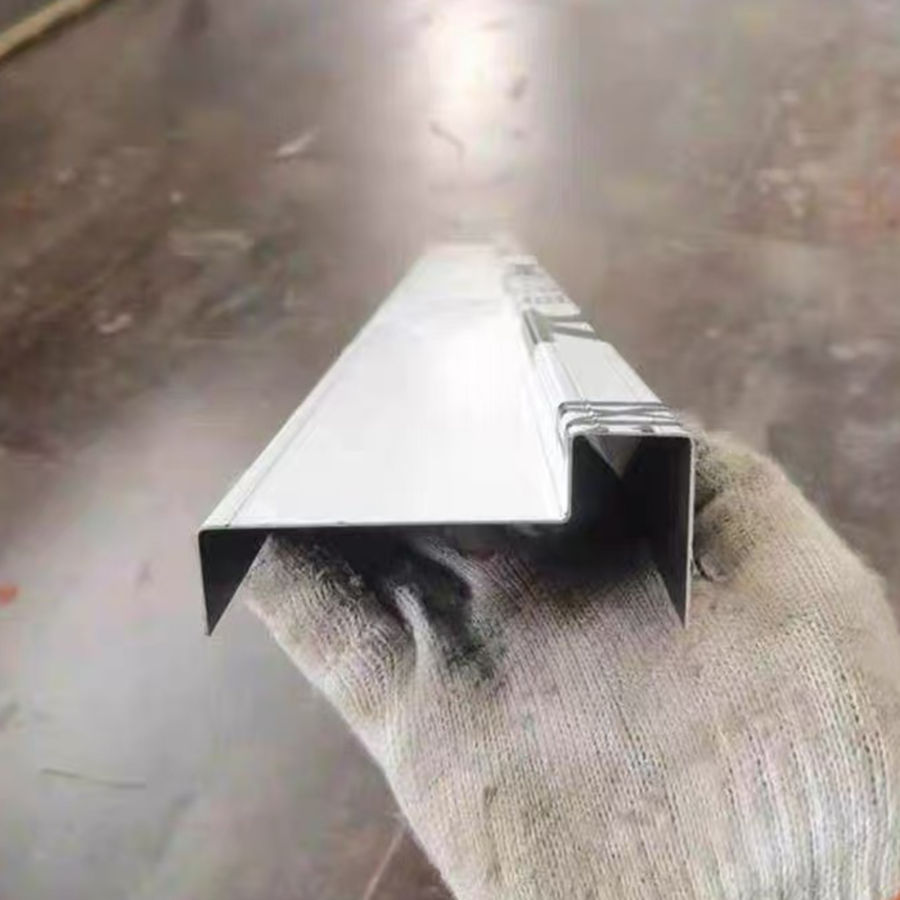
A threshold forms the barrier at the bottom of the opening, collects and discharges water, and manages the outside-to-inside transition. Most water that reaches the interior of an entrance door arrives here. The sill should fall outward, if only by a couple of degrees, so water leaves by gravity rather than evaporation. Weep slots sit at the lowest point of each drained chamber, with a baffle to stop gusting wind driving water back through.
Threshold height is the recurring compromise. A low threshold improves accessibility — around 13 mm is a common level-access target in North America and 20 mm under DIN 18040 — but leaves less depth for the channel and back dam. The workable answer is usually a shallow but wide channel with more frequent weep slots.
What Watertightness Ratings Measure
A watertightness figure means little without the standard behind it, because test conditions differ.
| Standard | What it tests | What to ask |
|---|---|---|
| EN 12208 | Static watertightness, classes 1A to 9A | Class and pressure in pascals — 6A is 250 Pa |
| EN 12207 | Air permeability, classes 1 to 4 | Class and leakage at 100 Pa |
| ASTM E331 | Water penetration under static pressure | Test pressure and pass criteria |
| AAMA 501.1 | Dynamic penetration with wind | Whether it was run, at what pressure |
Two cautions apply. A rating describes a complete assembly — frame, leaf, gasket, glass and hardware — not a profile sold by the metre. And the laboratory sample is a correctly installed door; the rating says nothing about a unit fitted without a sill pan.
Wind-Driven Rain Is a Harder Test
Static tests apply steady pressure to a wetted specimen; real weather arrives in gusts, and a pulsed load flexes the seal and can lift water over a back dam that steady pressure would not overcome. On coastal or high-rise sites, the dynamic result is the more informative one.

Diagnosing a Leak: Symptom, Cause, Fix
| Symptom | Likely cause | First action |
|---|---|---|
| Water at the bottom corners | Blocked weep slots or a gap in the corner gasket | Clear slots, check corner compression |
| Water along the hinge side | Flattened outer gasket or open frame-to-wall joint | Paper test, then inspect the perimeter |
| Water at the centre of a double door | Meeting stile gasket not compressed | Align the leaves before replacing seals |
| Damp patch above the head | Missing head flashing or a back-sloping sill above | Trace the wall detail |
Maintenance That Prevents Leaks
Clear every weep slot twice a year, before and after the wet season, with a soft brush or low-pressure air rather than a screwdriver. Wash gaskets with mild soapy water, then apply a silicone-based lubricant — petroleum products swell and soften EPDM. Check compression with a strip of paper, which should resist a firm pull along the gasket. Where a leaf has dropped and the lock side no longer meets the frame, adjust the hinges first; a sagging leaf is an alignment problem, not a gasket problem.
Frequently Asked Questions
How often should door gaskets be replaced?
When they harden, crack or fail the paper test, not on a fixed calendar. In residential use that is typically beyond a decade; on an exposed coast, inspect annually.
Can a leaking door be fixed by adding sealant?
Rarely. Sealant over a gasket joint or into a weep slot moves the water somewhere less visible. Restore compression and drainage instead.
Does a higher class always mean a better door?
It means the tested assembly resisted a higher pressure under that standard. A well-installed moderate-class door beats a high-class door with blocked drainage.
In Summary
Keeping water out is a system behaviour, not a component. The outer gasket breaks the rain, the middle chamber removes the pressure driving water inward, the inner gasket holds the air seal, and the threshold discharges what arrives. Every stage depends on a path to the outside staying open.