Installing Smart Locks on Aluminum Doors: Mortise, Wiring & Compatibility Guide
Fitting a smart lock to an aluminum entrance is not the same job as fitting one to a timber door. The leaf is framed in a hollow extruded profile, the lock pocket is machined into metal rather than cut into solid wood, and any cable must run through a chamber that may already be filled with insulation. Understand those three realities and the installation is routine.
Start With the Lock Format, Not the Brand
Most smart locks that fail on metal doors fail for a structural reason, not an electronic one. The first decision is which format the door can accept: a mortise lock whose body sits in a pocket machined into the leaf, a surface-mounted electronic lock that fixes to the interior face, or a factory-integrated electronic mortise supplied already prepared.
Quick answer: for a standard single-leaf aluminum entrance, a mortise-format smart lock is usually right, because the handle, keypad and cylinder align on one axis with the body inside the leaf. Choose a surface-mounted lock instead when the door is already finished, when the leaf is too thin for a deep mortise case, or on a pivot leaf with no usable stile.
Why Aluminum Doors Behave Differently
Leaf thickness is not the same as mortise depth
Aluminum leaves are built as plates over a frame. In Landran's single-door range the typical build is a 4 mm or 6 mm front plate over a 3 mm rear plate inside a 100 × 65 × 5.0 mm frame section, while heavier entrance models use front plates of 10 mm or 15 mm. What is available for a lock pocket depends on that geometry, not the outside thickness of the door. A mortise case is defined by its backset and case depth, and both must be checked against a section drawing.
The frame is a chamber, not a solid block
Extruded profiles are hollow by design: the voids make a thermal break possible and keep the leaf light enough to hang. On insulated entrance doors those chambers are normally filled with high-density flame-retardant polyurethane rather than left open. A filled leaf will not accept a cable pushed through it after manufacture, and a hollow stile may contain reinforcement exactly where you intend to drill — so ask for a section drawing with the reinforcement marked.
Mortise Versus Surface-Mounted: The Trade-Offs
| Consideration | Mortise smart lock | Surface-mounted lock |
|---|---|---|
| Body position | In a pocket machined into the leaf. | On the interior face of the leaf. |
| Preparation | Backset, case depth and stile width confirmed before fabrication. | Only fixing points and a cable route. |
| Suits best | New doors and leaves with a wide enough stile. | Retrofit, thin leaves, pivot leaves without a stile. |
| Main trade-off | Machining must be precise; access to both faces needed. | More visible interior hardware and a thicker profile. |
Wiring, Power and the Backup Question
Battery, hardwired, or both
Battery locks avoid the hardest part of the job, which is getting a supply to a moving leaf. A cable crossing from frame to leaf needs a flexible loop or concealed contact; on a pivot door the hinge line can carry a transfer contact. Where no supply can be run, choose a lock with a published battery life and a low-battery warning, and treat that warning as scheduled maintenance.
Fail-safe and fail-secure are not interchangeable
A fail-safe lock releases when power is lost, suiting egress routes; a fail-secure lock stays locked, suiting an entrance that protects property. For a residential front door, fail-secure with a mechanical override is usual — but the choice must be agreed before the lock is ordered, because it is a property of the lock body, not a setting.
Radio signals and metal leaves
Aluminum and steel attenuate wireless signals, so a radio module inside a metal leaf reaches less far than on a timber door. Test before final fixing: mount temporarily, pair the lock, and check from the positions people actually stand in. If reach is marginal, an external antenna or a nearby bridge solves it more cheaply than relocating the lock. Keep a mechanical override regardless.
What to Agree Before Fabrication
- Fix the leaf build-up first. Plate thicknesses, frame section and whether the chambers are filled decide which lock bodies are possible.
- Choose the lock, then sign the door drawing. Pass the cut sheet to the door manufacturer — approving a drawing before the lock is selected is the most common cause of an unusable pocket.
- Decide the power strategy. Battery, hardwired or hybrid, and where the supply originates. This affects the frame, not just the lock.
- Have the door maker machine in the factory. Factory machining uses fixed templates and happens before finishing, so the coating stays intact around the pocket.
- Agree the handover. Templates, fixing schedule, spares and who owns the first test cycle.
Contractor's Compatibility Checklist
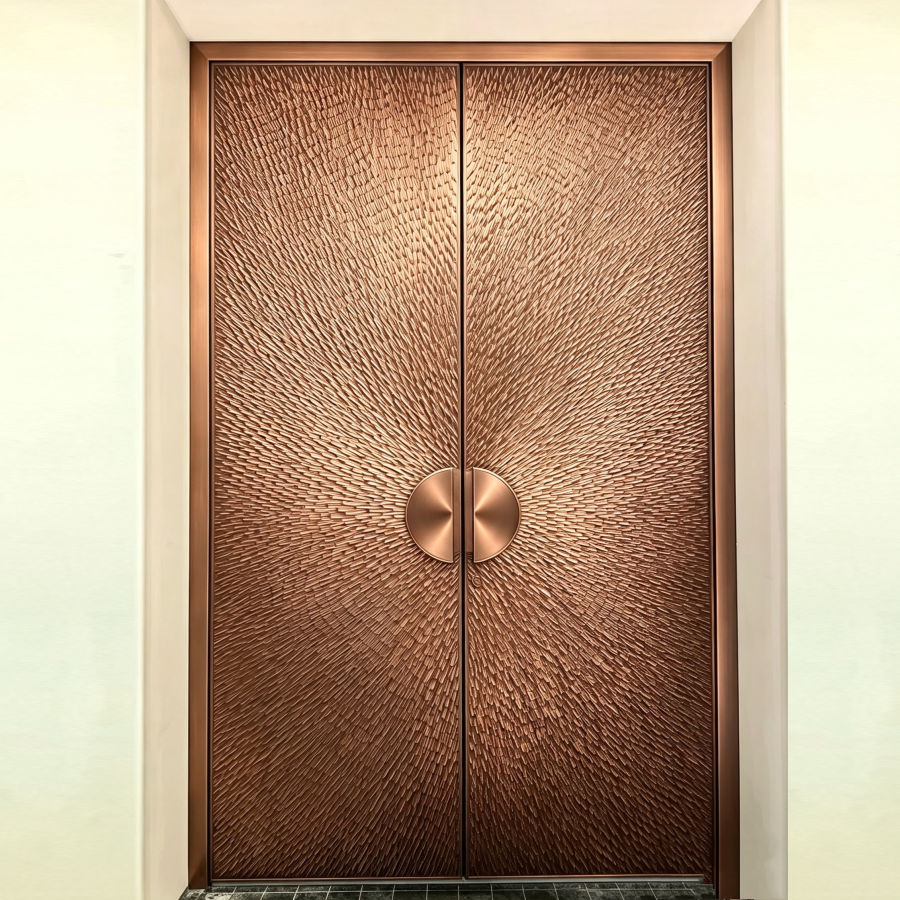
- Measure the stile, not the door. What counts is the width of the vertical member holding the lock case.
- Check the backset against the cut sheet. Handle, escutcheon and keypad footprint must all land on the stile.
- Locate reinforcement before drilling. Use the section drawing; never probe a finished leaf.
- Protect the coating. Tape and a template whenever a tool touches a coated or wood-grain face.
- Seal every penetration, then test the assembly. Check that the leaf still latches cleanly and that multi-point hardware is not held under load.
Frequently Asked Questions
Can any smart lock be fitted to an aluminum door?
No. The lock must match the available mortise depth, the stile width and the door's handing. Mortise locks need a machined pocket; surface-mounted locks need only fixing points and a cable route.
Do I need mains power at the door?
Not necessarily. Battery locks are common and avoid transferring a supply across a moving leaf. Where a supply is available, mains with battery fallback is the most resilient option for a frequently used door.
Will the door stay weather tight after installation?
It can be, if penetrations are small, placed away from the interior face and properly sealed. Aluminum conducts heat quickly, so an unsealed hole acts as a thermal bridge and can become a water path in wind-driven rain.
Factory machining or site cutting?
Factory wherever possible: templates are fixed, work happens before finishing and the leaf warranty stays intact.
Summary
A smart lock on an aluminum door is a compatibility problem long before it is an electronics problem. Confirm the leaf build-up and stile width, choose the format geometry allows, settle the power and fail-safe strategy in writing, and machine the door before it is finished.
Landran Door builds made-to-measure aluminum entrances and supplies matching hardware, including a mortise-format smart lock module in its OEM hardware range, so door and lock can be prepared together. Browse the aluminum door range, read more guides on the Landran blog, or contact the team with your door build-up and lock model for a fabrication drawing that already includes the pocket.