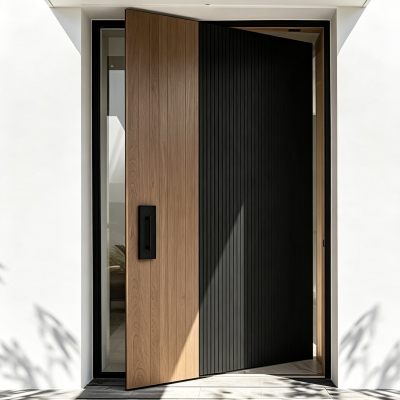
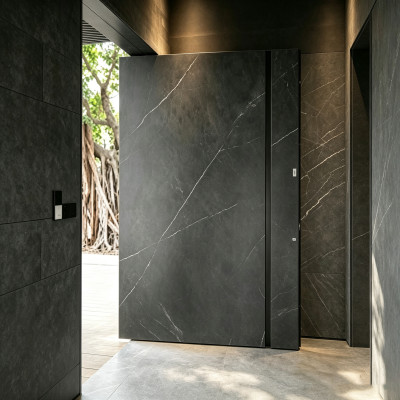
Inside Landran Door: How We Engineer, Finish & Test Every Aluminum Door
Every Landran Door starts in a 30,000 m² factory in Lishui, Foshan, and has to pass a set of checks before it is allowed onto a truck. This article walks through what happens in between: how the company founded in 2004 engineers each door, how it applies the finishes shown in the catalog, and what it checks before a door ships.
Who Is Behind the Landran Brand
Landran is the independent brand launched by Fancheng Group in 2010, produced by Foshan Landran Door Co., Ltd. The factory was founded in 2004 in Lishui Town, Nanhai District, Foshan — the city often called the capital of doors and windows in China. Today the company runs two standardized production bases and one R&D center, employs more than 300 people, and reports an annual output above 30,000 sets. Machining, frame fabrication, finishing, glazing and final assembly all happen under the same roof.
Stage One: Structural Engineering and Frame Fabrication
An aluminum entry door is engineered around its frame section and plate build-up before it is ever cut. In the Landran catalog, leaves are typically built with a 4 mm front plate and 3 mm rear plate, while heavy-duty constructions move to wider sections such as a 100×65×5.0 mm industrial frame, or a 120×65×3.0 mm frame on wide double doors.
Those numbers are not random. The frame carries the hinge loads, locking points and the weight of any glass; the plate thickness decides dent resistance. A 1.2 m villa double door and a 2.6 m pivot door have different structural budgets, so the profile and hardware are specified to match each size and use.
Factory reality check: for custom and oversized doors, the manufacturer should confirm section size, plate thickness and hinge positions against your opening before production. A supplier that quotes a large pivot or double door without asking about wall structure and door weight is a warning sign, not efficiency.
Stage Two: Precision Cutting and CNC Machining
Once drawings are confirmed, profiles are cut to length and machined for hardware. The factory runs more than 20 CNC engraving machines, and frame members are joined with corner brackets or welding depending on the profile system. Lock mortises, hinge pockets and drainage slots are all positioned here, so accuracy at this stage decides whether the hardware lines up later.
Door geometry is then checked against the measurements confirmed from the site rather than an ideal drawing, because the frame has to fit the actual opening. Small deviations in squareness are corrected in the factory, not discovered at installation.
Stage Three: Surface Finishing That Has to Last Decades
Finishing is the most visible part of a door and where shortcuts show up fastest outdoors. Landran runs in-house spraying lines with pre-treatment and acid-wash equipment, and offers two main coating routes: powder coating for solid colors, and wood-grain heat transfer that imitates timber grain on an aluminum base.
Pre-treatment is the step most buyers never see but the one that decides coating life. Aluminum needs a clean, prepared surface before powder is applied; skipping it is a common way to produce a door that pits or peels in coastal air after a season. Because the process is in-house, the same standard applies to a one-door sample as to a fifty-door order.
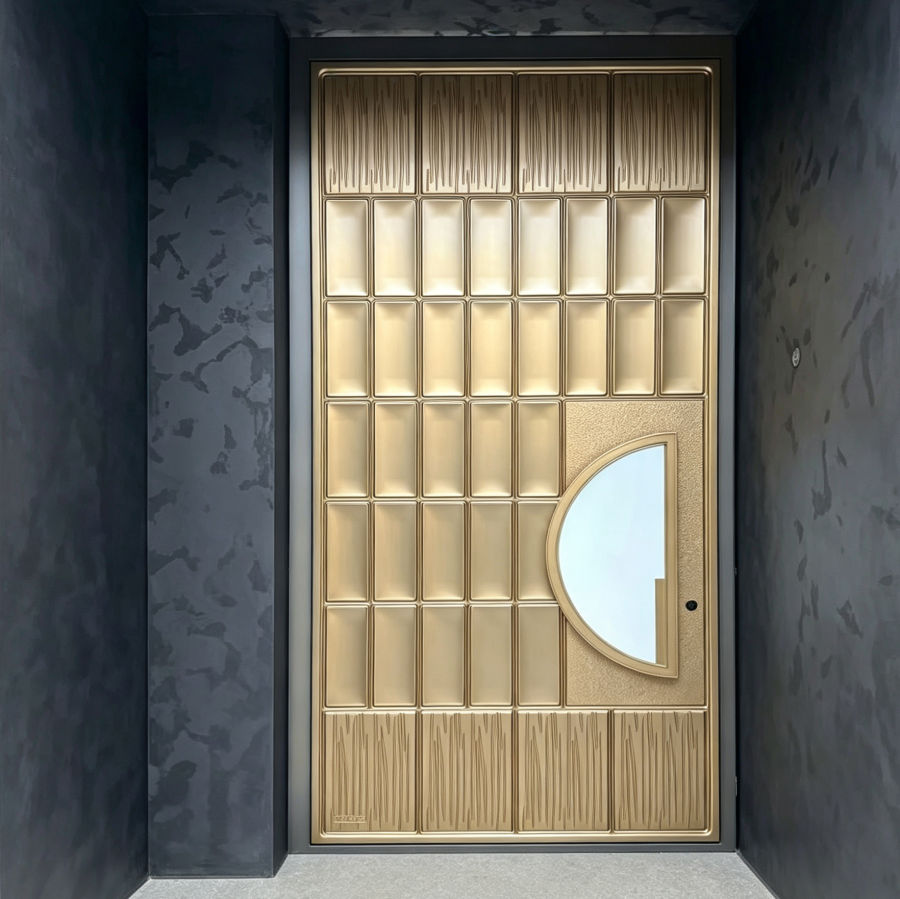
For projects that want different tones inside and out, dual-color finishing applies two coating passes on the two faces of the leaf — keeping the exterior weather-oriented and the interior coordinated with the room.
Stage Four: Glazing, Sealing and Assembly
Doors with glass are assembled around the glazing system rather than treated as a door with a window added later. Glass, gaskets and aluminum beads are matched so the unit stays weathertight under wind-driven rain, and the frame includes drainage paths that let any entering water escape outside.
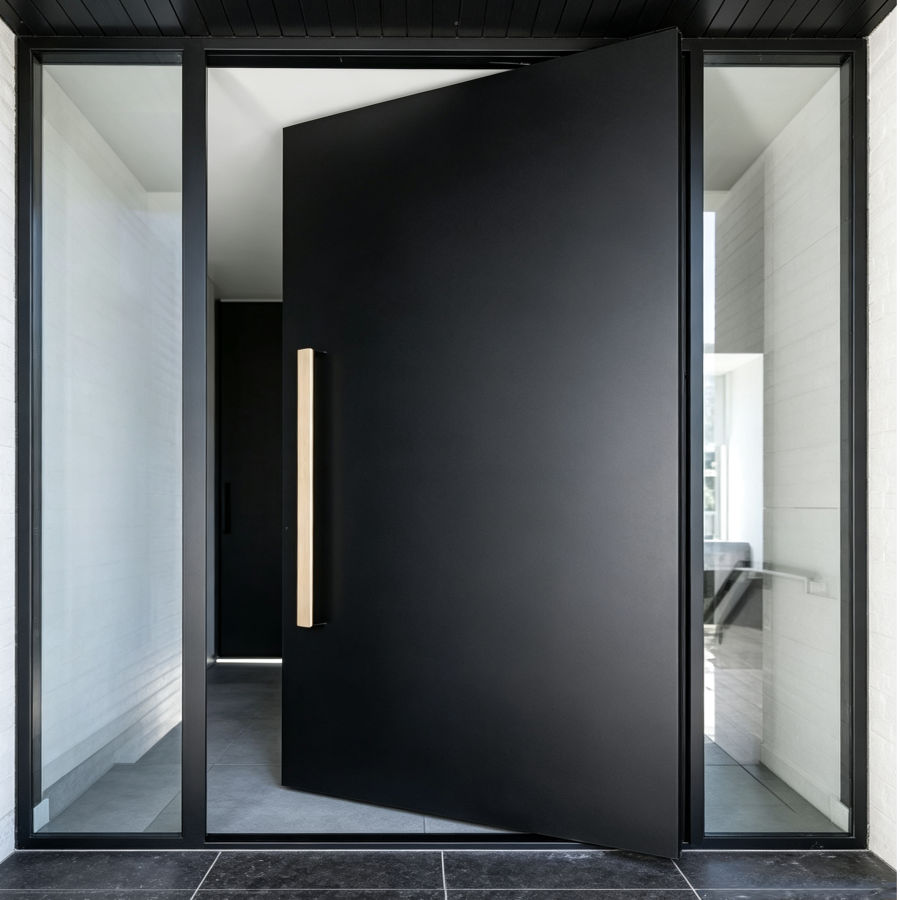
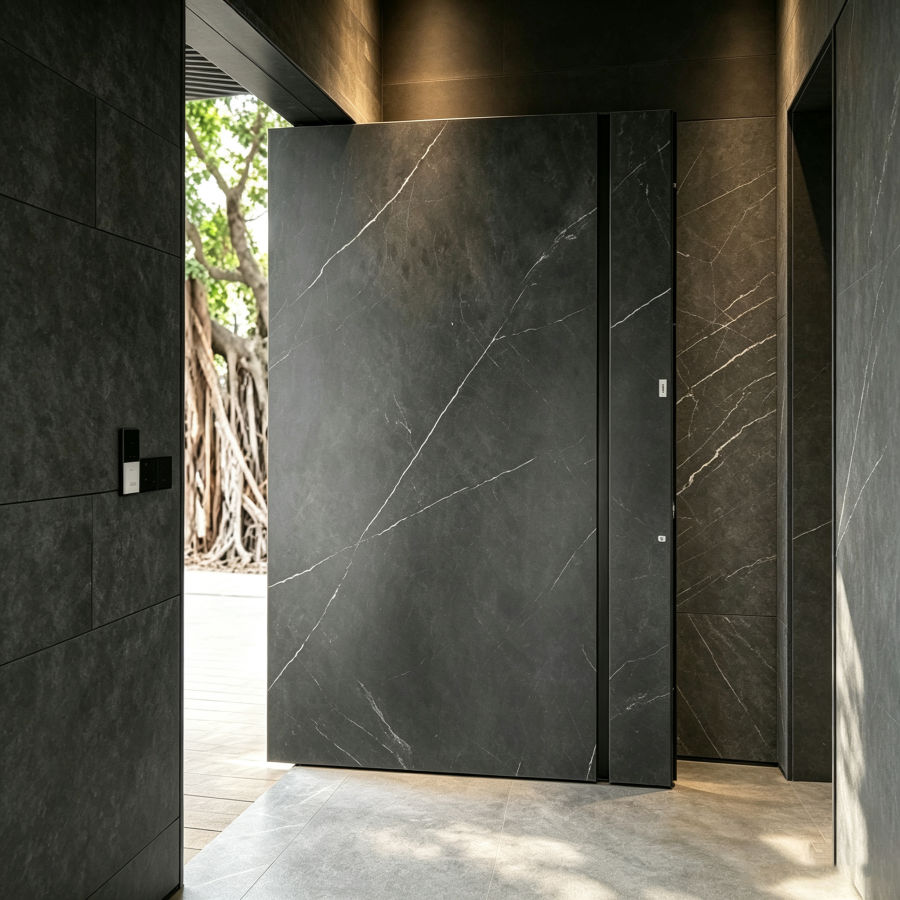
At the same time the weather seals — EPDM gaskets and bottom sweep strips — are fitted and the hardware is installed and adjusted. Large-format doors get extra attention here: a pivot door rotates on top and bottom hardware rather than side hinges, so the leaf must stay true as it swings, and alignment is rechecked after the hardware is torqued down.
Stage Five: Testing Before a Door Is Allowed to Ship
The factory test bench is the last gate, and it concentrates on the failures that actually happen on site.
| Check | What it simulates | Why it matters |
|---|---|---|
| Dimensional check | Comparing the finished frame to the confirmed opening dimensions. | Catches fabrication drift before the door is crated. |
| Squareness and fit | Closing and locking the leaf repeatedly, checking gaps and flushness. | Prevents field adjustments and draughty gaps later. |
| Hardware and load test | Cycling the door, checking hinges and lock engagement under weight. | Validates that hinges and multi-point locks work as a set. |
| Air and water checks | Checking gasket contact and drainage paths for leakage. | Roughly validates weathertightness before crating. |
| Finish inspection | Examining the coating for pinholes, thin spots and damage. | Protects coating life in real weather. |
Buyers should ask what a factory actually tests, because answers vary between suppliers. At Landran, every finished door is checked and cycled before packing, and evidence such as air-permeability or load-test reports can be requested during an inquiry.
What This Means for Buyers
For a homeowner, door quality is decided months before the door reaches the site — in the section choice, the pre-treatment bath and the assembly bench. For importers and contractors, a factory tour or a process questionnaire tells you more than a showroom photo. Landran welcomes customers to visit the Lishui factory.
Frequently Asked Questions
Where is the Landran Door factory located?
The factory of Foshan Landran Door Co., Ltd. is in Lishui Town, Nanhai District, Foshan, Guangdong, China, and covers about 30,000 square meters.
How long has Landran been manufacturing doors?
The company was established in 2004 as an aluminum profile processing and surface-treatment specialist. The Landran brand was launched in 2010, and production shifted to finished premium doors in the following years.
Are finishing and coating done in-house?
Yes. Powder coating and wood-grain heat transfer are done on the company's own spraying lines with pre-treatment equipment.
What tests are done before a door ships?
Each door is dimension-checked, closed and cycled, with hardware, seals and finish inspected before packing. Performance reports can be requested as part of the inquiry.
Summary: A Door Is Earned on the Factory Floor
Inside Landran Door, quality is distributed across five stages: structural engineering, precision machining, in-house finishing, careful glazing and assembly, and a test bench every door must pass. That is how the company delivers made-to-measure aluminum doors for apartments, villas and coastal projects with consistent results.
If you are evaluating a manufacturer, ask not only what a door looks like, but how it is made and what is checked before it ships. Browse the finished aluminum door collection, or contact Landran to arrange a factory visit or request process details for a specific model.