Dual-Color Aluminum Doors: Matching Interior and Exterior Finishes
An entrance door is the one part of a house seen from two worlds. From the street it must hold its colour against sun, rain and road grime; from inside it has to sit quietly with floors, joinery and paint. That is why dual-colour — two finishes on the two faces of one aluminium leaf — has moved from a one-off request to a routine line item.
Quick answer: a dual-colour door carries one colour reference for the outer face and another for the inner face, applied as two separate powder-coat passes over the same aluminium leaf. The frame can take a third reference. The change line normally sits on the leaf edge, so decide which face that edge belongs to, and approve every colour on a sample sprayed by the factory.
Why One Door Needs Two Colours
The two faces live in different climates. The outer face takes UV, driving rain and dust; the inner face answers to a heated room and a palette the interior designer has already fixed. A darker outer face hides road film and fingerprints far better than a pale one; a lighter or warmer inner face keeps a narrow hallway from feeling like a tunnel. Dual-colour removes the compromise by specifying the door twice, once per face.
How a Dual-Colour Finish Is Made
Two passes, two references
Powder coating is applied to one face, cured, then the leaf is turned and the second face is coated and cured. Masking at the leaf edge defines where one colour stops and the other starts. Because the leaf is handled and masked twice, the job is slower than a single-pass coat — which is why the premium is modest rather than large.
What "matching a colour" means
A RAL or NCS number fixes the hue, not the appearance. The same reference in matte, satin or gloss reads as three different colours in daylight, and a sand-textured or wood-grain film shifts tone again as light moves across it. Never approve a colour from a screen: ask for a sprayed sample of the actual powder and view it outdoors, beside the wall it will sit against.
Choosing the Exterior Face
- Dark tones — black, charcoal, bronze — hide dirt and weathering best. The trade-off is solar gain, which is a thermal-break and core problem rather than a colour problem.
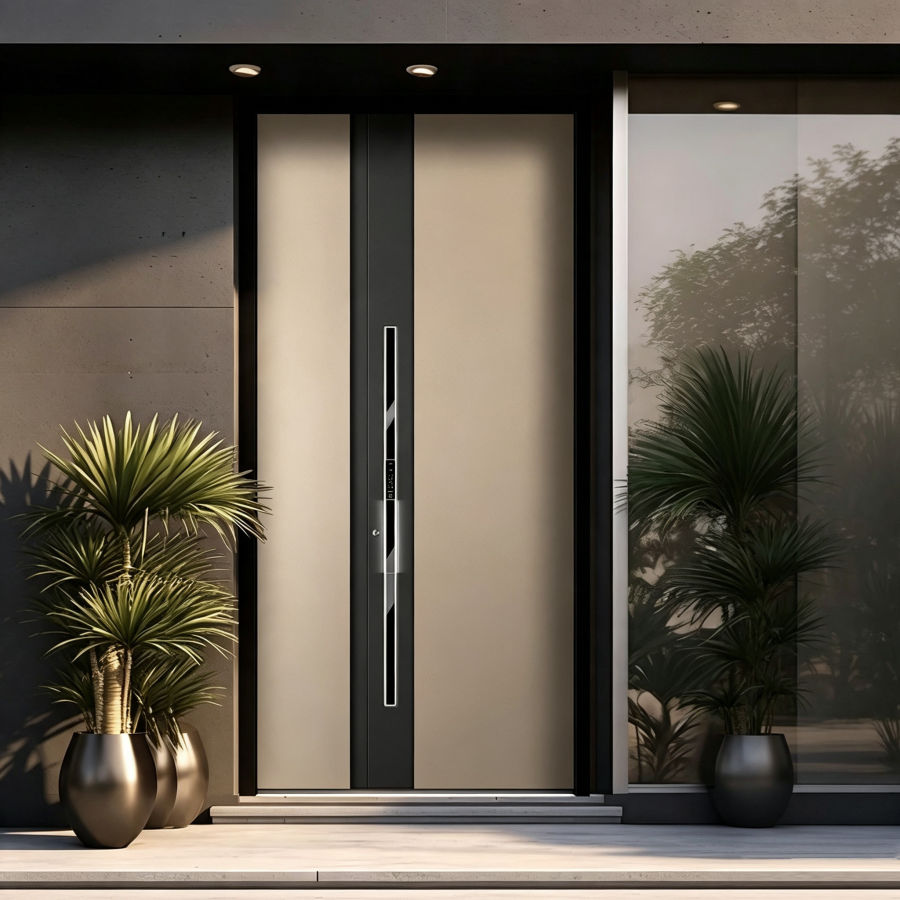
- Light tones reflect heat and read as larger from the street, but show splash-back above the sill; a satin or lightly textured finish earns its keep here.
- Coastal exposure is a coating-class question. Ask which powder system and warranty class the factory uses: an architectural-grade polyester behaves very differently from a standard powder after five years of salt air.
Choosing the Interior Face
Start from what is already fixed in the room — floor, stair, joinery, wall colour — and let the inner face belong to that family rather than the street:
- Match the floor, not the walls. Floors are expensive to change and set the tone; walls are repaintable.
- Watch the light level. In a narrow or north-facing hall a pale inner face lifts the space; in a bright open plan a dark inner face turns the door into the feature it already is.
- Think about wear. Matte and textured finishes hide scuffs from bags and bikes far better than gloss, and touch up more convincingly.
Pairings That Work
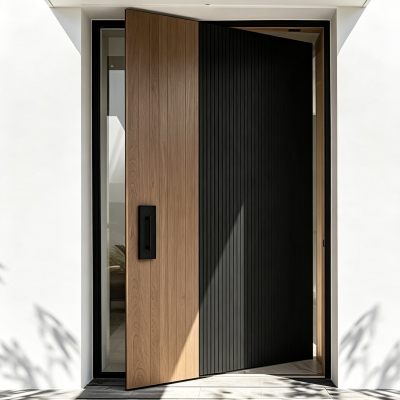
- Charcoal outside, pale oak wood-grain inside. The most requested residential combination: street-side presence, interior warmth.
- Same reference, two sheens. A satin outer face and a matte inner face differentiates without introducing a second colour.
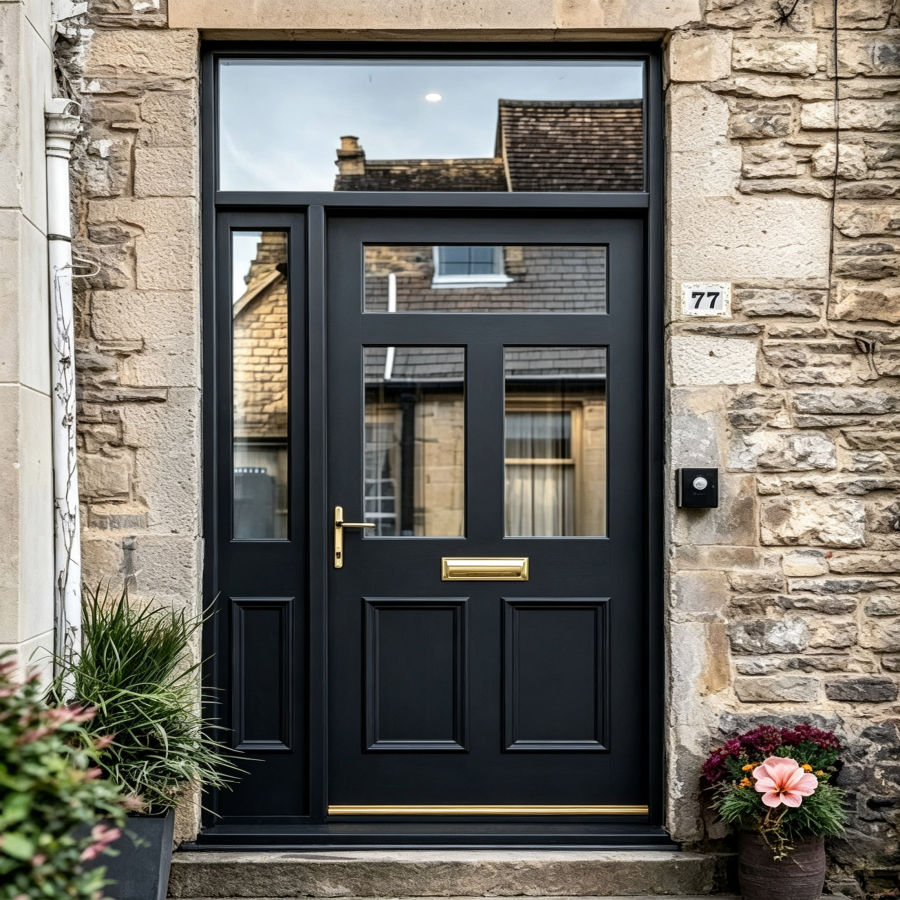
- Black outside, bronze detail. Hardware and inlay change how a door reads without changing the coating, keeping touch-up simple.
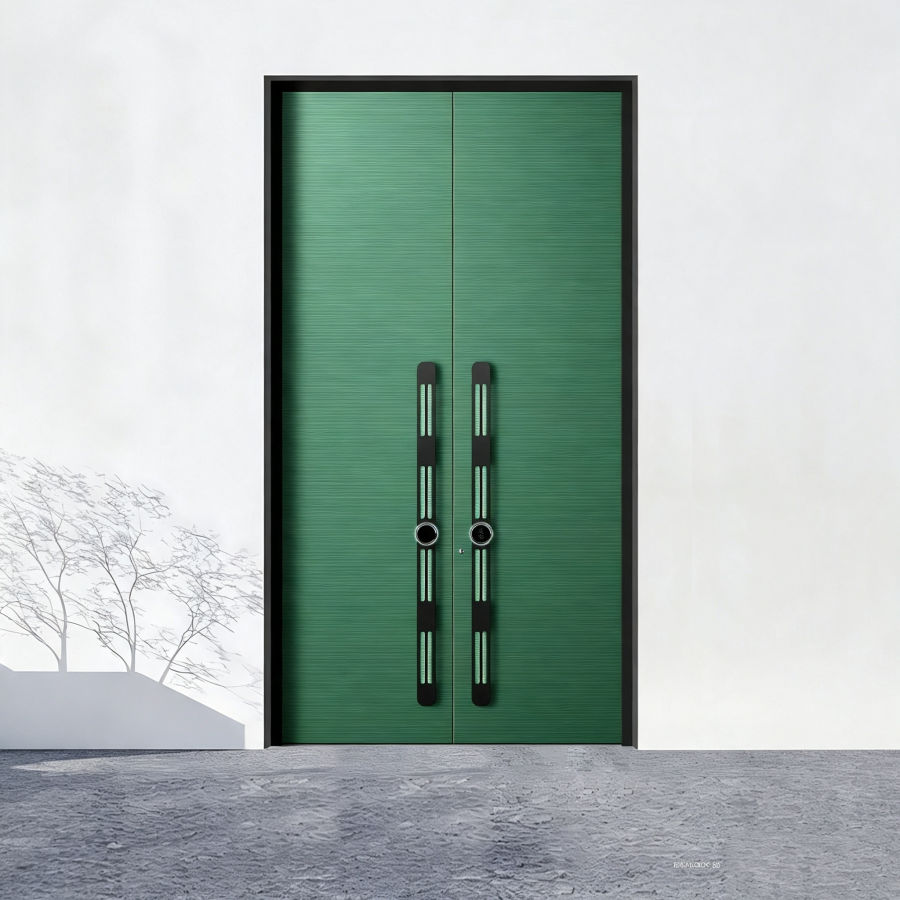
- Coloured leaf, black frame. Contrast by component rather than by face — a green or taupe leaf in a black frame stays legible from the street.
Stop at three references: outer, inner, and frame or hardware. A fourth colour almost always reads as a mistake from one side or the other.
Details That Decide Whether It Looks Right
- The leaf edge. When the door closes the edge is still visible from the threshold; decide deliberately which colour it carries.
- Hardware finish. A black handle and cylinder on a pale inner face draws a hard line across the door; a matching finish lets it disappear.
- Glazing and gaskets. The bead is the visual frame around the glass, and black gaskets on a white leaf change the whole composition.
- Touch-up pens. Two colours need two pens — ask for both at handover, with the powder code for each.
What to Send the Factory
- Opening width, height and wall thickness, with handing and a dimensioned elevation.
- Outer and inner face references — RAL or NCS number, wood-grain code, or an approved sprayed sample — plus the sheen for each.
- Frame reference, and whether the architraves are split.
- Hardware finish, glazing build-up, gasket or bead colour.
- Position of the change line.
Frequently Asked Questions
Can any aluminium door be supplied dual-colour?
Yes — solid or glazed, single, double, unequal double or pivot. The leaf is coated per face, so the extrusion shape matters less than the geometry: deep returns and applied mullions make masking slower and should be discussed before the order is fixed.
Does dual-colour cost much more?
Expect a modest premium: a second spray and cure pass plus hand masking, more on textured finishes and more again if the frame is also split.
Will the inside colour be visible from the street?
Only at the leaf edge and rebate, and only at an angle. If that matters, ask for the change line to be set so the outer colour wraps the edge.
Will the two faces age differently?
They will. The outer face takes the UV and the weather, so it ages first — especially a dark face on a sun-exposed elevation. Choose a coating class suited to the exposure.
Summary
Treat the two faces as two specifications: pick the outer face for weathering and street presence, the inner face for the floor and the light, and let the frame and hardware resolve the join. Approve every colour on a sprayed sample, fix the change line, and ask for touch-up in both finishes.
Landran Door manufactures made-to-measure aluminum entrance doors in Foshan, China, covering single, double, unequal double and pivot models with plate thicknesses from 4 mm to 15 mm, in powder-coated, heat-transfer wood-grain and anodized finishes, solid or glazed. Browse the aluminum door range, read the other guides on the Landran blog, or contact the team with your opening dimensions and the two colour references you want to pair.