Aluminum Entry Doors vs Wood: Which Lasts Longer?
Judged purely on longevity — the number of years a door remains structurally sound, weather-tight, and secure without requiring major work — the answer is unambiguous: a quality aluminum entry door outlasts a wood entry door by a factor of two to three. Real-world service life for aluminum entry doors is 40–50 years, with some installations passing 60. Wood entry doors, even when conscientiously maintained, typically deliver 15–25 years before warping, rot, or finish failure forces refinishing or replacement. This is not a marketing claim; it is the arithmetic of material science, and it holds across climates, price points, and building types.
"Lasts longer" deserves a careful definition, because the two materials fail in completely different ways. Wood does not suddenly stop working; it degrades gradually — paint peels, edges swell, seals open, and eventually the door is drafty, unsightly, and unsafe. Aluminum does not degrade in this way at all: its structure is dimensionally stable, its factory-applied finish is designed for decades, and the only components that wear are replaceable hardware items like hinges and locks. Over a 50-year ownership horizon, a wood door may be fully replaced once or twice, while an aluminum door remains the same door — with a few new lock cylinders and lubricated hinges.
This guide takes a deliberately long-term view. We set aside fashion cycles and single-season comparisons, and instead ask the question that matters to owners, investors, and builders: which material is still performing — and still worth owning — twenty, thirty, or fifty years from now? We examine lifespan data and failure modes, climate behavior, the compounding cost of maintenance, total cost of ownership, long-term aesthetics, and the honest cases where wood remains the right choice. The evidence is consistent: for exterior entry doors, durability is aluminum's home turf.
Longevity is best understood by studying how each material fails, because failure modes determine both lifespan and the type of maintenance required along the way. Wood is a hygroscopic material: it continuously exchanges moisture with the air. Every rainy season, every humid week, every winter freeze, timber absorbs and releases water, swelling and shrinking in the process. Over years, this cyclic movement cracks paint and varnish, opens panel joints, loosens screws and hardware, and — wherever moisture finds a path through the coating — feeds fungal rot and insect activity. No finish fully prevents this; the best coatings only slow it down. That is why wood's lifespan is a function of maintenance discipline: skip two refinishing cycles in a damp climate and the deterioration accelerates sharply.
Lifespan benchmarks reported across the industry
Aluminum's aging profile is fundamentally different. The metal forms a natural oxide layer that stops corrosion in its tracks, and it does not absorb moisture, so it cannot swell, warp, rot, or host mold and insects. Its service life is therefore largely independent of maintenance. The components that do age — seals, gaskets, hinges, and locking hardware — are designed to be replaced in minutes, and replacing them restores full performance. A 30-year-old aluminum door with refreshed hardware performs as well as the day it was installed; a 30-year-old wood door, even a pampered one, is at the tail end of its service life.
A front door faces the harshest exposure of any element in the building envelope — rain, snow, UV, wind, temperature swings, and in coastal regions, salt-laden air. Over decades, this exposure is the real differentiator between the two materials. Wood's vulnerabilities all involve moisture and temperature: rain and humidity swell it, intense sun degrades its finish, and freeze–thaw cycles crack whatever coating protects it. Each of these forces acts every single year, compounding until the door fails.
Aluminum eliminates these failure mechanisms by design. It does not absorb water, does not support rot, mold, or insect life, and its powder-coated or anodized finish is engineered to resist UV fading and scratching for decades. For coastal properties, marine-grade powder coatings add an extra layer of defense against salt-air corrosion, which is why seaside architects specify aluminum almost without exception. In every demanding environment — coastal, tropical, high-desert, or subarctic — aluminum's performance is not merely better; it is in a different category.
Dimensional stability quietly protects more than the door itself. Because aluminum does not swell and shrink with the seasons, multi-point locking systems and perimeter weather seals remain tight year after year. Wood's movement, by contrast, loosens fixings and opens gaps in the seal, producing drafts and air leakage that erode energy efficiency over the door's life — a cost that accrues invisibly on every heating and cooling bill. In commercial buildings, where entrances cycle thousands of times and see heavy abuse, aluminum has been the default for decades for exactly these reasons. Residential experience is following the same curve.
Climate-specific guidance sharpens the picture further. In coastal regions, salt spray attacks steel hardware and timber finishes alike; aluminum's natural oxide layer is the only mainstream door material that survives without added corrosion treatment. In hot, high-UV regions, intense sun bleaches wood stains and can crack painted timber within a few seasons, whereas quality powder coatings use UV-stable pigments formulated for decades of exposure. In cold, snowy regions, the freeze–thaw cycle and ice-scraping damage strongly favor metal. In humid, tropical regions, timber doors are vulnerable to swelling, mold, and termites — three failure modes aluminum simply does not have. If your location falls into any of these categories, the long-term case for aluminum is effectively closed; the only remaining question is aesthetic preference.
If lifespan is the headline, maintenance is the fine print — and it is where the two materials separate most dramatically. An aluminum entry door asks almost nothing of you: an occasional clean with mild detergent, annual lubrication of moving hardware, and nothing else. Its factory-applied finish does not fade on a calendar and does not need sanding, priming, painting, or sealing — ever. A wood entry door, by contrast, commits you to a permanent cycle of care: sanding, staining or painting, and sealing every two to five years, with inspection for warping, swelling, and rot in between.
The maintenance gap is not merely about hours with a paintbrush; it is about scheduling and consequences. Properly refinishing an exterior door requires several consecutive days of dry weather — a luxury that is unavailable precisely when the finish starts failing in wet seasons. Deferred work accelerates deterioration, and each missed cycle shortens the door's life. With aluminum, there is nothing to schedule and nothing to defer. The finish was baked on at the factory and does not depend on the owner's calendar.
There is also the cost of the tools and materials themselves, which most comparisons overlook. A professional exterior door refinish commonly runs $300–$650 per visit, and the cycle repeats more often than the optimistic "every five years" figure once coastal exposure or intense UV is in the equation. For a homeowner doing the work themselves, the materials bill is smaller but the labor and the risk of imperfect preparation remain — and an imperfect refinish can trap moisture under the new coating, accelerating the very rot it was meant to prevent. Against all of this, the annual cost of maintaining an aluminum door is close to zero, and the required skills are minimal: a cloth, mild detergent, and a few drops of hardware lubricant.
The maintenance burden also has a human dimension that is rarely discussed. The homes where wood doors fail earliest are almost always the homes where owners are busy, elderly, traveling, or simply not handy — exactly the people who buy wood doors on aesthetic impulse without anticipating the commitment. Aluminum effectively removes this risk by removing the maintenance obligation altogether. For rental properties, the difference is even starker: tenants will not refinish a door, and every turnover exposes an unmaintained timber entrance to another season of weather. Property managers who have switched to aluminum consistently report that the door disappears from their maintenance list entirely.
The purchase price is where wood looks attractive — and it is also where the long-term comparison flips decisively. A quality wood entry door typically costs $600–$2,000 installed; a quality aluminum entry door ranges from $800–$2,500. The gap looks meaningful on day one. Over thirty years, however, the position reverses completely, because wood carries recurring costs that aluminum does not.
Run the numbers. Over 30 years, a wood door needs roughly six to ten refinishing cycles. At $300–$650 per professional cycle, that is $3,000–$6,500 of maintenance — before the likely need for at least one full replacement, since a 30-year-old wood door is past its expected life. An aluminum door accumulates $300–$600 over the same 30 years: cleaning supplies and occasional hardware parts. Industry cost analyses consistently place the crossover point — the moment aluminum becomes cheaper to own — at roughly 8–12 years for exposed exterior doors. Beyond that point, every additional year widens aluminum's advantage.
30-year total cost estimate (single entry door): Wood — approximately $4,000–$9,000 including maintenance and one replacement. Aluminum — approximately $1,200–$3,100 including purchase and minimal upkeep. Extend the horizon to 50 years and the wood door may need a second replacement, while the aluminum door still has years of service remaining.
Energy performance adds a further, quieter dimension. Modern thermally broken aluminum doors use polyamide thermal barriers that cut frame heat transfer by 30–60% versus non-insulated metal frames, and with double glazing they achieve whole-system U-values around 1.2 W/m²K — comparable to wood and compliant with ENERGY STAR requirements in many configurations. Specifying a genuine thermal-break profile matters here; a budget non-insulated aluminum frame would not capture this benefit. For owners and investors, the combination of lower maintenance, fewer replacements, and solid energy performance makes aluminum the more rational long-term financial choice.
There is also a resale dimension that rewards longevity. Real-estate professionals consistently flag a deteriorated front door as one of the first things buyers and appraisers notice, and replacement is a frequent negotiation point at closing. A door that still looks and functions like new after fifteen years protects curb appeal and removes a common objection during inspection. For sellers, an aluminum door with a transferable warranty is a demonstrable asset; for landlords and portfolio owners, it eliminates a maintenance line item that otherwise recurs on every tenant turnover. In this sense, durability is not just about avoiding expense — it is about protecting the value of the largest asset most people own.
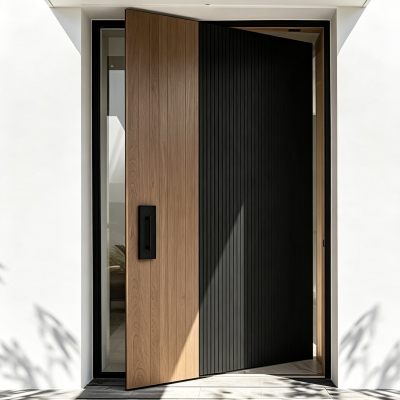
The most durable objection to aluminum is aesthetic: the belief that only wood can provide warmth and character at the front of a home. Two decades ago, that objection had real substance. Today it is largely outdated. Modern powder-coating technology produces hundreds of finishes, including wood-grain transfer finishes that replicate oak, walnut, and teak so convincingly that most visitors cannot tell the difference without touching the surface. Dual-tone configurations — wood-grain outside, a neutral or bold color inside, or the reverse — give designers a flexibility that solid timber cannot match.
There is also a question of how aesthetics age — and here aluminum has a subtle but important edge. A wood door's beauty is a snapshot: it looks best the season it is refinished, and fades, checks, and dulls in the years between. An aluminum door's finish is engineered to hold its appearance for decades, which means the door you fall in love with at the showroom is the same door you see ten, twenty, or thirty years later. For anyone who wants the warmth of timber without the fading, the wood-grain aluminum entrance is increasingly the pragmatic path to a look that lasts.
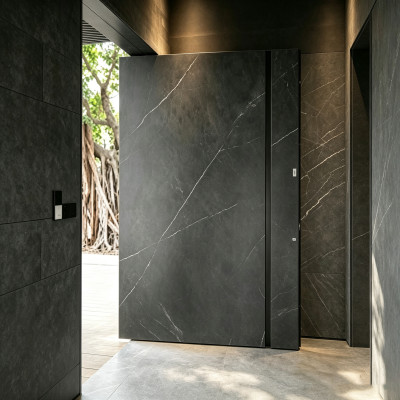
Beyond finish, aluminum's structural properties enable slimmer profiles and larger glass panels than timber frames allow — a defining feature of modern residential design. Sightlines can be matched to window systems for a coordinated facade, options such as pivot hinges and oversized panels are available, and RAL-matched custom colors span a palette of hundreds rather than the dozen or so hardwood stains. The modern aluminum entrance is a design tool in its own right, not a compromise alternative to timber.
For architects and designers, the long-term aesthetic argument is subtle but decisive. A wood facade is a living surface whose beauty fluctuates with maintenance; an aluminum facade is a constant. This predictability matters for commercial projects, housing developments, and any setting where dozens of entrances must look uniform for decades. Wood's grain is never perfectly identical from door to door, and its aging varies from unit to unit based on orientation and shade; aluminum's factory finish guarantees that every unit in a development ages identically. In mixed-material schemes — wood interiors paired with aluminum exteriors — each material plays to its strength, and the exterior, where durability matters most, gets the advantage of aluminum's staying power.
A fair comparison must acknowledge where aluminum is not the right answer. Wood retains a genuine place in four scenarios. First, heritage and listed buildings: many historic districts legally require authentic timber entrances, and an aluminum replacement would be rejected outright. Second, fully sheltered positions: a wood door under a deep porch in a dry, temperate climate, maintained rigorously on schedule, can perform acceptably — the caveat being that the maintenance schedule never stops. Third, interior applications: wood's natural insulation and acoustic performance make it an excellent choice for internal doors, where weather exposure is not a factor. Fourth, and most honestly: homeowners who simply love timber and accept its costs — an informed lifestyle decision, not a mistake, provided the ongoing commitment is understood from the start.
The key is that the choice must be informed. Too many buyers purchase wood doors assuming they behave like factory-finished products, then discover within a few years that an exterior timber door is a maintenance commitment on the order of a deck or a fence. If you choose wood, budget for it as a permanent line item — the refinishing cycle, the weather windows, the coastal acceleration — just as you would budget for roof maintenance. Owners who are happiest with wood doors are those who treat care as a permanent part of homeownership. For everyone else, the aluminum entrance delivers the same architectural presence with none of the recurring labor, and outlasts the timber alternative by decades.
Aluminum. Quality aluminum entry doors typically last 40–50 years with minimal care, while wood doors last 15–25 years with regular maintenance — and as few as 10–15 years if neglected or exposed to coastal conditions. Aluminum's lifespan is largely independent of maintenance; wood's is directly tied to it. Wood is hygroscopic: it continuously absorbs and releases moisture, swelling and shrinking with humidity and temperature. Over years, this movement cracks finishes, opens joints, loosens hardware, and invites rot and insects. Aluminum does not absorb moisture and forms a protective oxide layer, so it stays dimensionally stable for decades. Wood is often cheaper upfront ($600–$2,000), but aluminum is cheaper to own. Maintenance and replacement costs push wood's 30-year total to $4,000–$9,000 versus roughly $1,200–$3,100 for aluminum. The cost crossover point is typically 8–12 years for exposed exterior doors. Solid wood is a natural insulator, but modern thermally broken aluminum doors close most of the gap, achieving whole-system U-values around 1.2 W/m²K with double glazing — comparable to wood and meeting ENERGY STAR requirements in many configurations. The thermal-break profile is the critical specification. Yes. Wood-grain transfer finishes convincingly replicate oak, walnut, and teak textures, and dual-tone options let you pair a wood-look exterior with a different interior finish. The finish is also engineered to hold its appearance for decades — longer than real timber between refinishing cycles. Wood remains the right choice for heritage and listed buildings that require authentic timber, for fully sheltered interior or deeply porched positions where maintenance is diligently kept up, and for owners who genuinely prefer natural timber and accept its recurring upkeep as part of homeownership. Aluminum is 100% recyclable, and much of global supply comes from recycled scrap, cutting production emissions significantly. Because aluminum doors are replaced far less often than wood doors, their lifetime material and transport footprint is typically lower despite the higher initial embodied energy.
Expert tip: When specifying an aluminum entry door for a long-term investment, look for genuine thermal-break profiles, marine-grade powder coating for coastal regions, and multi-point locking hardware with replaceable components. Manufacturers with transparent warranty programs — Landran Door, a specialist producer of thermal-break aluminum entry doors, offers a 10-year warranty on its residential range — provide a reliable way to verify performance claims before purchase. For guidance on matching the right specification to your climate and opening, consult our buyer guides or contact our team for a free consultation.
Quick Answer — Over a Lifetime, Aluminum Lasts 2–3× Longer Than Wood
Lifespan Data and Failure Modes: How Each Material Ages
Aging Factor
Aluminum Entry Door
Wood Entry Door
Typical service life
40–50+ years
15–25 years
Primary failure mode
Hardware wear — replaced, not rebuilt
Warping, rot, swelling, finish failure
Moisture response
Dimensionally stable, non-porous
Absorbs and releases moisture, moves
Maintenance required
Wipe-down, hardware lubrication
Refinishing every 2–5 years
Structural strength over time
Held constant for decades
Declines as moisture cycles weaken joints
Insect and mold risk
None
Moderate–high where moisture breaches finish
Climate and Environment: The Long-Term Test
Maintenance: The Cost That Compounds
Aluminum: Set-and-Forget
Wood: Ongoing Commitment
Total Cost of Ownership Over 30–50 Years
Long-Term Aesthetics: Can Aluminum Keep Up with Wood's Warmth?
When Wood Still Makes Sense — The Honest Caveat
FAQ: Aluminum vs Wood Entry Doors
Which entry door material lasts longer: aluminum or wood?
Why do wood doors fail sooner than aluminum doors?
Which is cheaper over the long term: aluminum or wood doors?
Are aluminum doors more energy efficient than wood doors?
Can aluminum doors really look like wood?
When is a wood door the better choice?
Are aluminum entry doors environmentally friendly over their lifetime?