Aluminum Entry Door Security: Multi-Point Locks Explained
Technical Articles · Door Security Series
Aluminum Entry Door Security: Multi-Point Locks Explained
A front door is only as strong as its weakest link. A beautiful aluminum entry door with a cheap single-point lock, a hollow strike plate, and a fragile glass lite can be opened in seconds by someone who knows what they are doing. Multi-point locking is the single most effective upgrade a door buyer can make — but it is also the most misunderstood. This guide explains how multi-point locks actually work, which security grades matter, and why the frame and glass around the lock decide whether the system performs.
Quick answer: Multi-point locks engage 3 to 7 locking points along the door edge, distributing force across the whole frame instead of concentrating it on one bolt. Independent testing and European security standards (EN 1627) show that a correctly installed multi-point system with a Grade 1-2 lock, a reinforced frame, and impact-resistant glass is roughly five times harder to force open than a single-point lock of the same cylinder quality. The lock matters, but the frame reinforcement and the glazing decide how much of that protection you actually get.
Quick Answer — Multi-Point Locks Are 5x Harder to Force
Property-crime statistics keep pointing at the same uncomfortable number: roughly one in three residential burglaries enters through the front door, and most of those are forced-entry attacks on the lock or the frame, not sophisticated lock-picking. A conventional single-point deadbolt, even a good one, is a one-bolt defense. Attackers can lever the bolt back with a crowbar, bend the plate, or simply kick hard enough to break the bolt out of the strike. The single point of engagement is the weakness.
A multi-point lock replaces that single bolt with a continuous chain of locking points — typically 3, 5, or 7 along the door edge: a main deadbolt at the handle plus shoot bolts and hook bolts at the top and bottom of the door, and sometimes intermediate points on the lock side. When you turn the key or the handle, all of them engage at once and bite into the frame top, bottom, and side. The kick now has to defeat several independent points at the same time, which is why the practical resistance jumps so dramatically.
The "5x harder" figure is not marketing rhetoric; it comes from the testing regime behind EN 1627, the European standard for burglar-resistant windows and doors. A door tested to RC2 resists a skilled attack for about 3 minutes; RC3 for about 5 minutes; RC4 for about 10 minutes. Single-point entry doors rarely reach RC3 at all, while multi-point systems with reinforced frames routinely certify at RC3 and RC4. In real terms, a would-be intruder spends more than five times longer — and makes far more noise — against a multi-point door, which is exactly what the standard measures. The honest caveat: the lock alone cannot deliver this. The cylinder class, frame reinforcement, and glazing all have to be specified together, which is what the rest of this guide walks through.
How Multi-Point Locking Systems Work
Inside the door edge, a multi-point lock is one continuous locking bar (often called the "espagnolette" or gearbox) driven by a central cylinder and handle. Turning the key or lifting the handle moves the bar vertically and horizontally, pushing the locking points out of the edge and into the frame. Every point engages mechanically from the same single action — you never lock five bolts one by one.
The four locking-point types you will meet
- Shoot bolts (vertical bolts): round or rectangular bolts at the top and bottom of the door that slide into the frame header and threshold. They defeat lifting and levering at the hinge side and stop the door from being bowed out of its frame.
- Hook bolts: J-shaped bolts that rotate into a matching keeper in the frame. Once engaged, they cannot be pulled straight back — the shape physically anchors the door edge to the frame. This is the point that defeats crowbar attacks.
- Main deadbolt: the central bolt at the handle height, usually with a hardened anti-saw insert and a 25-30 mm throw. It is the primary point that resists direct drilling and sawing attacks.
- Mushroom cams / anti-lift pins: mushroom-headed pins on the lock side that interlock with the frame. If an attacker tries to lift the door off its hinges, the cam heads catch inside the keepers and the door will not move.
Why the geometry matters: with a single deadbolt, a crowbar placed between the door edge and the frame applies enormous leverage to one bolt. With multi-point locks, the bar distributes that leverage across four or more anchor points spread over the full height of the door. The bending load on any individual bolt drops by an order of magnitude, and the door behaves more like a welded unit than a panel held by one latch.
What a proper lock cycle looks like
- One action, many points: turning the key (or lifting a handle on lever-action systems) drives the gearbox.
- Top and bottom engage first: the shoot bolts extend into the frame header and threshold, locking the door's vertical travel.
- Hook bolts rotate: the hook points swing into their keepers, anchoring the door edge laterally.
- Deadbolt throws: the central bolt extends into the reinforced strike, and mushroom cams drop into their pockets.
- Verification: you hear (and often feel) the multi-stage click of all points seating. On certified systems the door is only considered locked when every point is home.
The honest limitation: multi-point locks are more expensive than single-point deadbolts, and they are harder to adjust after installation. A door that sags, a frame that warps, or an installer who does not shim the keepers properly will make a multi-point lock feel stiff, noisy, or misaligned. Buy the lock and install it as a system — the mechanism is only as good as its alignment.
Lock Grades Explained: Which Security Level Do You Need?
Lock performance is tested against formal grading standards, and the grade — not the marketing name — is what tells you how a lock behaves under attack. Three grading systems cover most of the world's residential entry doors, and serious manufacturers certify against all three where relevant.
| Grade / Class | Anti-destruction resistance | Typical bolt coverage | Best for |
|---|---|---|---|
| Grade 1 (ANSI/BHMA A156.13) | Highest; heavy-duty cycles (800,000+), resists forced entry and brute force | Multi-point, 3-7 points | Primary entry doors, high-risk areas |
| Grade 2 (ANSI/BHMA) | Medium-heavy duty; standard residential use | Multi-point or reinforced single | Residential entry doors, most homes |
| Grade 3 (ANSI/BHMA) | Light duty; interior and low-risk use | Usually single-point | Interior doors, secondary entries |
| Class A / B / C (GB 17565, CN) | Class A is highest: longer anti-destruction time, hardened cylinder, drill-resistant plate | Multi-point expected | Chinese residential security doors |
| RC2 / RC3 / RC4 (EN 1627, EU) | RC2 ≈ 3 min, RC3 ≈ 5 min, RC4 ≈ 10 min of skilled attack resistance | Multi-point required above RC2 | Whole-door certification in Europe |
Three practical rules come out of the standards. First, the cylinder class matters as much as the bolt grade: a C-grade cylinder (in the Chinese GA/T 73 classification) resists technical opening for 10 minutes or more and includes drill protection and anti-bump pins, while A-grade cylinders can be opened in under a minute by a skilled attacker. Second, do not mix a premium multi-point mechanism with a cheap cylinder — the cylinder is the front door of the lock, and attackers attack the door, not the wall. Third, if your insurer or local code references a grade, buy the certified whole system rather than trying to assemble components that were never tested together.
For an entry door you will live behind for 20 years, the sensible target is Grade 1 or 2 mechanism hardware with a C-grade cylinder and a whole-door rating of at least RC2, ideally RC3. Anything less is adequate for a secondary door but not for the front door. Landran Door ships its multi-point systems as matched sets — mechanism, cylinder, keepers, and reinforced strike — so the weakest link is never an afterthought.
Aluminum Frame Reinforcement: The Hidden Security Layer
The lock is the most visible part of door security, but the frame is where most forced entries actually fail. A multi-point lock throws its bolts into the frame — if the frame bends, splits, or the strike plate pulls out, the lock's resistance is meaningless. This is why security-focused aluminum doors are engineered as reinforced systems, not just extruded boxes with locks bolted on.
The four reinforcements that matter on an aluminum entry door
- Profile wall thickness: security-grade aluminum door profiles use 2.0 mm or thicker walls in the lock and hinge zones (standard interior profiles are often 1.2-1.5 mm). The thicker the wall, the harder it is to bend the edge away from the keepers. GB 17565 and EN 1627 testing both reward this.
- Steel insert reinforcement: a cold-rolled steel or stainless reinforcement bar runs inside the aluminum profile along the lock side, carrying the keeper screws and absorbing prying loads. The aluminum provides the finish and the weather resistance; the steel does the security work.
- Strike plate anchoring: the strike — the metal plate the bolts bite into — must be fixed into the wall structure, not just screwed into the frame's thin aluminum. Security strikes use extra-long screws or anchor bolts through the frame into the masonry, timber sub-frame, or steel lintel behind it.
- Anti-removal hardware: hinges with non-removable pins, anti-tamper screws on the lock side, and concealed hinge fixings stop an attacker simply unscrewing the door off its frame. This is cheap to add and closes the attack path most people never think about.
The 10-minute test: when evaluating any aluminum entry door, ask the manufacturer for the wall thickness of the lock-side profile, whether a steel insert is standard, and how the strike plate is anchored. If the answer involves "optional upgrade" or "screws into the frame," that door is not a security door — it is a door with a lock. Landran Door's security range uses 2.0 mm lock-zone profiles, a full-length steel insert, and a strike anchored into the sub-frame with hardened fasteners as standard, which is the difference between an entry door and a secured entry.
The honest caveat is about the installation, not the product. The strongest frame ever extruded is defeated by a sloppy install: oversized fixing holes, missing shims, or a frame that is not anchored to the structure every 40-60 cm. A security door is only as good as its anchor points into the building, so the frame reinforcement story has to end with the installer doing their job.
Smart Lock Integration: Biometric, Keypad, App Control
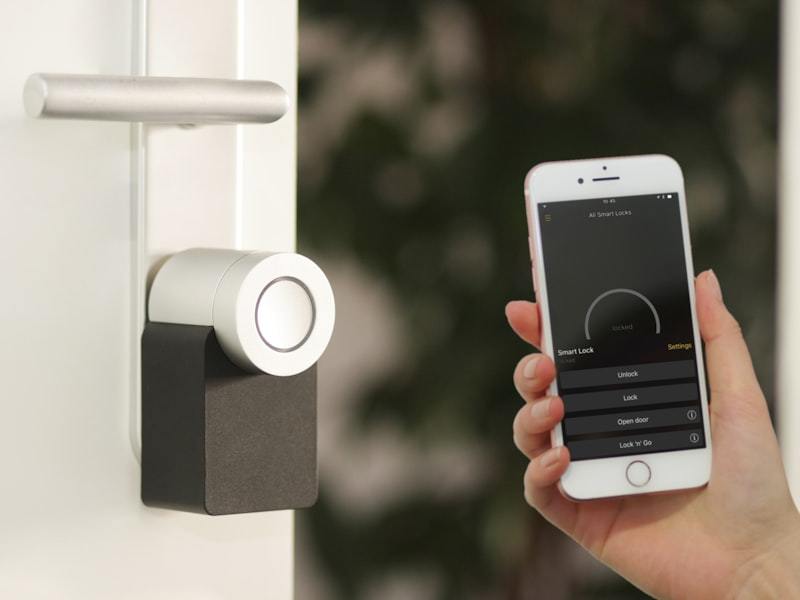
The smart lock market has been growing at a double-digit pace every year since 2020, and for good reason: a keypad means no lost keys, a fingerprint sensor means no fumbling, and app control means you can check whether the door is locked from anywhere on earth. The smart home is a genuine security convenience — but the way it combines with multi-point hardware matters.
There are two fundamentally different ways to add smart access to a multi-point aluminum door. Pre-installed (factory-integrated): the manufacturer machines the lock cavity, routes the wiring (or battery compartment) in the frame, and certifies the smart lock together with the mechanism. The cylinder is replaced by an electronic drive that throws the same multi-point bar, so you get fingerprint, keypad, and app access over a genuine multi-point mechanism. This is the approach used on Landran Door's Smart Core option, and it is the only approach that keeps a whole-door security certification intact.
Retrofit (aftermarket): you buy a Yale, Samsung, or August smart lock and install it on the door yourself. This works well when the existing mechanical lock is a standard cylinder — the smart lock simply replaces the cylinder — and most quality smart locks support the standard 92 mm (or 60/70 mm) backset cylinder format used by European multi-point gearboxes. Compatibility is usually good, but there are three honest catches: the smart lock's motor only drives the central bolt on many retrofit units (the shoot bolts engage when you lift the handle, which the smart lock cannot do for you); you must verify the specific gearbox format against the lock's compatibility list; and the retrofit is not tested as a system, so a whole-door RC rating may not survive the modification.
What to check before pairing a smart lock with a multi-point door
- Gearbox format: confirm the smart lock matches the multi-point gearbox (brand and backset) — Yale, Samsung, and August publish explicit compatibility lists.
- Full locking: prefer a smart lock that throws all points, not just the central bolt; otherwise you are back to a single-point defense in smart clothing.
- Power and failure mode: battery-powered locks should keep a physical key or thumb-turn override, because a dead battery is the classic smart-lock lockout.
- Wiring: if the lock needs power, a pre-routed frame channel beats surface wiring for both looks and tamper resistance.
The honest bottom line: a smart lock is an access convenience layered on top of a mechanical security system. The best smart integration (factory-integrated electronic drive over a multi-point bar) gives you convenience without giving up the 5x force resistance described earlier. A cheap retrofit that only drives one bolt quietly trades your multi-point security for single-point convenience — which is a poor deal if you chose the door for security in the first place.
Impact-Resistant Glass: Laminated vs Tempered
Every door security guide eventually hits the same embarrassing fact: an intruder does not need to defeat your lock at all if the glass beside it can be smashed in 10 seconds. If your aluminum entry door has a glass lite, the glazing is part of the security system whether you planned it or not. Two glass families dominate the choice, and they are not interchangeable.
| Property | Tempered glass | Laminated glass (PVB interlayer) |
|---|---|---|
| How it breaks | Shatters into small blunt granules; hole forms immediately | Breaks but stays bonded to the PVB interlayer; hole takes repeated strikes |
| Forced-entry resistance | Low — a hole can be made in seconds | High — minutes of sustained attack, often rated to security glazing classes |
| After breakage | Panel is open; glass falls away | Panel stays in place, delaying entry and injury |
| Sound dampening | Moderate | Better — the PVB layer adds mass and damping |
| Typical use | Safety glazing where strength against impact/shingles is needed | Security lites, skylights, hurricane zones, entry doors |
Laminated glass gets its name from the polyvinyl butyral (PVB) interlayer sandwiched between two (or more) panes. When the outer pane shatters, the fragments stay glued to the PVB film, and the film itself resists penetration — the attacker must cut or tear through the layer, which takes tools, time, and noise. Security-rated laminated lites are tested to standards like EN 356 (P4A/P5A/P6B classes) or the US forced-entry guidance, and a P5A or P6B lite is a genuinely hard target. The bonus nobody expects: the same interlayer measurably improves sound insulation and blocks the majority of UV, so the security upgrade also makes the entry quieter and the interior fabrics last longer.
The honest trade-offs: laminated glass is heavier (so the hinges and pivot hardware must be specified for the extra weight), noticeably more expensive than tempered, and — the point buyers rarely consider — it only helps if the whole lite is laminated. A door with a laminated panel but a thin, weakly fixed perimeter bead is still defeatable at the edges. On a security build, specify laminated glazing as a factory option with reinforced perimeter fixing, and consider it mandatory if the door sits within roughly a meter of the lock or has a full-height lite. Landran Door offers laminated security lites (up to P6B) with matched hinge reinforcement on its security line, because a lock system and a fragile window in the same door is a contradiction no standard can fix.
Common Security Mistakes to Avoid

Most entry-door security failures are not exotic. They are the same handful of mistakes repeated in thousands of homes — and they are all preventable if you know what to look for.
The seven mistakes that quietly destroy door security
- Wrong cylinder grade: pairing a premium multi-point mechanism with an A-grade cylinder. The cylinder is attacked first; a C-grade with drill and bump protection is the minimum for an entry door.
- Short-throw or single-bolt "multi-point" claims: some products advertise "multi-point" while only the central bolt actually reaches the frame. Count the engaged points, or better, check the certification label.
- No frame reinforcement: the strongest lock thrown into a 1.2 mm frame and a sheet-metal strike is a lock bolted to tin foil. Profile thickness, steel inserts, and anchored strikes are not optional on an entry door.
- Ignoring the glass: a security lock beside an un-laminated lite is a lock with a bypass. If glass is within reach of the lock, it must be laminated or protected by grilles.
- Misaligned keepers after installation: a multi-point lock that visibly scrapes or needs a shoulder-push to close was never aligned. Misaligned points engage partially or not at all.
- Visible or removable hinge pins: exterior hinge pins that can be punched out turn a locked door into a door you can lift off its frame. Non-removable pins or security hinges are mandatory.
- Trusting the sticker over the install: an RC-certified door installed into an unanchored frame, on soft timber that has rotted, or with the strike floating on plasterboard is worth less than the certificate. The installation is part of the product.
The pattern behind all seven mistakes is the same: treating the door, the lock, the frame, and the glass as separate purchases instead of one security system. When you buy a door, ask for the system-level specification — mechanism grade, cylinder class, frame wall thickness, steel insert, strike anchoring, glazing class, and hinge type — and refuse to buy components that were never designed to work together. Landran Door publishes this exact security specification sheet with every multi-point door, so the system claim is verifiable on paper, not just in the brochure.
FAQ: Aluminum Entry Door Security
Are multi-point locks really harder to force open?
Yes, by a wide margin. A multi-point system engages 3-7 bolts into the frame, so a kick or crowbar attack must defeat several independent anchor points simultaneously instead of one bolt. Under the EN 1627 testing regime, doors with reinforced multi-point systems typically certify at RC3 (about 5 minutes of skilled attack resistance) or RC4 (about 10 minutes), while single-point doors rarely reach RC3. Practically, that resistance translates to roughly 5x the forced-entry time, which is the figure most security engineers cite.
What lock grade should an aluminum entry door have?
For a primary entry door, choose Grade 1 or Grade 2 mechanism hardware (ANSI/BHMA A156.13) with a C-grade cylinder (GA/T 73) that includes drill and bump protection, and a whole-door target of at least EN 1627 RC2, ideally RC3. The grade describes the mechanism, the class describes the cylinder, and the RC rating describes the tested whole door — you want all three specified together.
Is a smart lock as secure as a traditional key lock?
A quality smart lock (Yale, Samsung, August, and similar) is as secure as a good mechanical lock, with the added risks of electronics and power. The decisive point is how the smart lock interacts with a multi-point mechanism: a factory-integrated electronic drive that throws all points keeps the multi-point resistance intact, while a retrofit that only drives the central bolt effectively downgrades you to single-point security. Always keep a physical key or thumb-turn override for power failures.
Do I need laminated glass on my entry door?
If the door has glass within easy reach of the lock, laminated glass is strongly recommended, because an intruder does not need to defeat the lock if the glass can be smashed. Laminated lites (with a PVB interlayer) resist penetration for minutes and are tested to classes like EN 356 P4A-P6B, whereas tempered glass shatters into an opening in seconds. Laminated glass also improves sound insulation and blocks most UV as a bonus.
Can any aluminum door be fitted with a multi-point lock?
Mechanically, many aluminum doors can accept a multi-point gearbox, but the result is only a security door if the frame is designed for it — 2.0 mm+ profile walls in the lock zone, a steel insert, reinforced keepers, and an anchored strike. Retrofitting a multi-point lock into a thin, unreinforced frame moves the weak point to the frame itself. For real security, buy the door and the lock as one engineered system, or specify the reinforcement when ordering.
What is the single most important security upgrade for an existing door?
For an existing single-point door, replacing the cylinder with a C-grade anti-drill, anti-bump cylinder and reinforcing the strike plate with long screws into the sub-frame is the highest-value upgrade, because it attacks the two weakest points (cylinder attack and strike pull-out) at low cost. For a new door, spend the money on the system: multi-point mechanism, reinforced frame, and laminated glass, because retrofitting any of those later is far more expensive than specifying them at the start.
Closing Thoughts From the Landran Door Team
Entry door security is a system problem, and the system has four parts: the mechanism, the cylinder, the frame reinforcement, and the glazing. Buy all four at the same grade, and the door becomes something an intruder simply walks past — statistics and testing agree that most forced entries are crimes of convenience against the weakest nearby door. Buy them as mismatched components, and the weakest part becomes the door you actually live behind.
At Landran Door, every multi-point entry door ships as that complete system: Grade 1-2 mechanisms, C-grade cylinders, 2.0 mm lock-zone profiles with steel inserts, sub-frame-anchored strikes, and laminated security lites up to P6B — with the full specification published so you can verify the claim. If you are specifying or replacing a front door and want help matching the security level to your actual risk, the team can walk you through the options through our project inquiry channel.