Aluminum Door Soundproofing: How Acoustic Entry Doors Cut Street Noise
The traffic noise that reaches an upstairs bedroom usually crosses the entrance rather than the walls. A wall is layered and deep; an entry door is a thin panel with a gasket around its edge. Whichever of three paths — mass, leakage or flanking — is weakest decides how quiet the room feels.
Why the Entry Door Usually Sets the Limit
An insulated wall already separates several layers, so its sound reduction is high enough that the entrance becomes the controlling element in the facade. That is why a well-built home can still feel noisy: the leaf, its glazing and its perimeter are where sound gets in. Aluminum is not the problem; a light leaf with a thin panel is, because surface mass per unit area is the strongest single lever over transmission loss.
Quick answer: a heavy leaf alone will not make an entrance quiet. Sealing, glass build-up and the frame-to-wall junction each impose their own ceiling, and the lowest one governs the result.
Three Paths Sound Takes Through a Door
Sound crosses an entrance in three ways, and it always takes the easiest.
- Mass-controlled transmission through the leaf: the panel acts as a diaphragm, vibrates and re-radiates sound indoors.
- Leakage through openings: the perimeter, the threshold, a letter plate, or a frame that was never packed and sealed.
- Flanking around the leaf altogether, through the wall, the reveal or an adjacent window.
Mass: Buying Attenuation by the Millimetre
Transmission loss rises with surface mass. The mass law predicts roughly 6 dB of extra attenuation each time surface density doubles, which is why a 10 mm solid panel outperforms a 4 mm one by a wide margin. Thicker plate also stiffens the leaf and shifts the coincidence dip, where a thin panel transmits more than mass law suggests. Landran Door builds entrance leaves with plate thicknesses from 4 mm to 15 mm, so leaf mass can be matched to the noise problem rather than to the drawing alone.

Glass Is the Weak Element in a Glazed Entrance
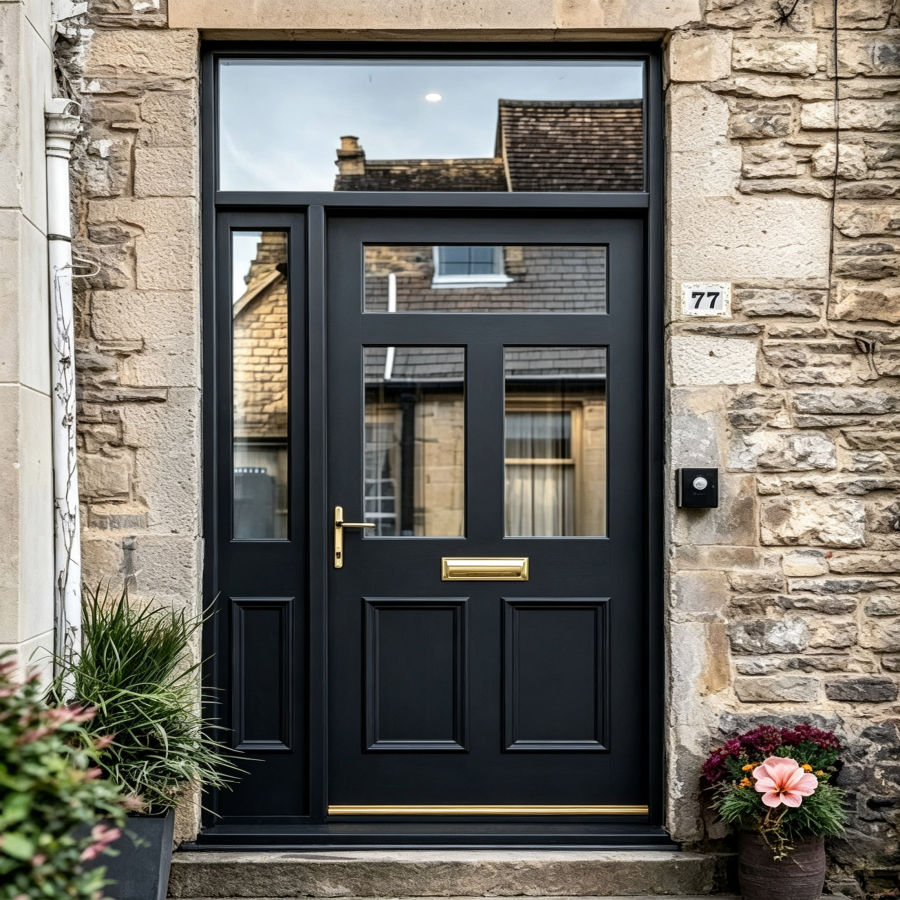
A single pane is far lighter than the leaf around it, so a heavy leaf carrying a thin glazed panel performs like the panel, not like the leaf. A laminated pane sandwiches a plastic interlayer between two sheets, and that interlayer damps the pane, filling in the coincidence dip and improving the low-frequency performance plain glass handles badly. Published figures put 6 mm monolithic glass near Rw 30, a laminated pane of similar thickness a few decibels higher.
In sealed units the cavity matters as much as the panes. Very narrow cavities rigidly couple the sheets and give almost no benefit; 12 to 16 mm is the usual sweet spot, and asymmetric thicknesses stop both panes resonating together. Triple glazing is not automatically quieter: narrow symmetric cavities can perform worse at traffic frequencies.
Seals and Thresholds: Where Air Leaks, Sound Leaks
Air and sound travel together, so the perimeter is where most real-world performance is won or lost. A continuous gasket on the head and jambs, compression held evenly by a multipoint lock, and a bottom seal that genuinely touches the sill matter more than another millimetre of plate.
Small openings punch above their weight. As a working approximation, a gap with one thousandth of the total door area caps attenuation near 30 dB, and a gap of one hundredth caps it near 20 dB. A few millimetres of daylight along a threshold can therefore cap a well-built entrance at a mediocre number, however heavy the leaf. Components such as the mf-003 sealing strip and the SC-001 automatic sweep strip exist to close exactly those lines.
The bottom is the hardest line to seal. Head and jamb gaskets sit in a rebate that presses them shut, while the bottom must seal against a floor that may not be level. A drop-down or sweep seal paired with a threshold offering a flat, continuous surface is the usual answer.
Flanking Paths That Bypass the Leaf
Sound is indifferent to the leaf and will happily travel around it. The weak links are usually the frame-to-wall junction, a reveal that was never packed and sealed, a shared structural edge, or glazing elsewhere in the room. A door rated 40 dB set into a wall achieving 30 dB returns roughly 30 dB room to room. Treat the entrance as part of a wall assembly and specify the sealing detail at frame stage, not on the day of installation.
Reading STC and Rw Numbers
Two rating systems cover most specifications, and they are close relatives. STC is measured under ASTM E90 and rated to E413, from 125 Hz to 4,000 Hz. Rw is measured under the ISO 10140 series and rated to ISO 717-1, from 100 Hz to 3,150 Hz. Quote the figure in the system your project uses. For traffic and aircraft noise, OITC is more informative because it extends down to 80 Hz. Whichever figure is quoted, laboratory ratings describe a perfect installation, and field performance is typically several decibels lower.
Specifying a Quieter Entrance
- Describe the noise source. Traffic, aircraft, plant and voices have different spectra and need different countermeasures.
- Give the opening and the wall build-up. A door cannot be judged in isolation from the wall it sits in.
- Ask for laboratory test data under ISO 10140 and ISO 717-1, or ASTM E90 and E413, plus an OITC figure if road noise is the driver.
- Specify the glass build-up, not the glass thickness — for example an asymmetric laminated acoustic pane with a 12 to 16 mm cavity.
- Specify continuous double-line gaskets and a drop-down bottom seal above a flat threshold.
Frequently Asked Questions
Will acoustic foam on the door reduce street noise?
No. Foam reduces echo inside the room but adds no mass and seals no gaps, so it barely changes transmission.
Is a heavier leaf always quieter?
Only until sealing becomes the limit; past that point extra mass produces no audible improvement.
Does triple glazing always beat double glazing for noise?
Not necessarily. Narrow symmetric cavities can perform worse at low frequency.
Can an existing door be improved without replacing it?
Often yes, by renewing the gaskets, fitting a drop-down bottom seal and sealing the frame perimeter.
Summary
A quiet entrance is an assembly, not a product. Mass sets the theoretical ceiling, glazing usually becomes the practical constraint, sealing decides whether either is realised, and flanking paths can quietly undo all three.
Landran Door manufactures made-to-measure aluminum entrance doors, including solid, double, pivot and glazed models, with plate thicknesses from 4 mm to 15 mm. Browse the aluminum door range, read more technical guides on the Landran blog, or contact the team with your opening dimensions, wall build-up and noise target.